Showing posts with label europe. Show all posts

Thursday, May 29, 2014

A Cosmic Dance of Bursting Decadence and Withheld Permissions - The Dennis Severs House

So if you're following the blog, it's no secret that East London is probably my favorite place in the world. When I moved here it kind of felt like one of those coming-of-age movies from the 90s about 'the summer that changed everything' but with way more hard liquor and a better soundtrack. And indeed, in certain parts of Shoreditch, the obnoxiousness of never-ending adolescence is still strong in the streets. Regardless - East London is where I became the person I always wanted to be: it's where I fell in love, it's where I started dying my hair and wearing clothes that fit, and against the best backdrop in the world I was finally happy: hundreds of years of history and an ever-changing landscape. This is not to say I'm immune to its flaws. If I have to walk into one more hipster bar and pay 9$ for a beer while some dingus wearing Google Glass explains why I should be doing their design work for free, I'm going to yak.

Though I'm not the only American to fall prey to the charms of Spitalfields, there have been many before me but who exceeded all collective eccentricities and definitely had more money. Was the king of the desperate romantics: Dennis Severs.

Dennis Severs had been brought up in post-war California, and while the likes of Reyner Banham were dreaming of the place-less reinvention that the West provides, Severs longed to be part of something older. After years of costume dramas on TV, Severs arrived in London in the 1970s, but found something not at all to his tastes. It was a rapidly industrializing place and the city workers were getting more encompassing by the day. Instead of accepting his disappointment and adjusting, he simply ignored the development around him and decided to live in the past. Sort of like the Amish or Japan's rejection of firearms for 300 years.


The past became Severs medium: he began by buying an authentic handsome cab and giving rides. But after his stable was demolished by developers, he needed to find another outlet. So he bought a ramshackle house at 18 Folgate Street and started to work.

He decided that he was going to invent a family of Huguenots silk merchants, their beginnings as hard working protestants to grasping decadence and further to their inevitable decline. Each room in the house was going to be a total experience, sights, smells, sounds. All in perfect silence while Severs described this fantastical history. Here's a quick recap starting from the bottom-up:

Basement Cellar - The remnants of the leper burial plot from St. Mary's Spital (hence the name: Spitalfields)

Basement Kitchen - The beginning of sensory development, in an almost Frank Lloyd Wright philosophy, he reminds the viewer that the Latin word for hearth is focus. So the fire is the axis on which the rest of the home moves (editorial note: I've always disagreed with this statement, though maybe because I've always had central heat)


First Floor Dining Room - The "Jarvis Family" (again, a complete invention by Severs) move in and are the kind of hard-working patriarchs one might expect. Food half eaten, a clean, functional, warm space filled with orders and announcements.


Second Floor Parlor - It seems a generation later, their protestant beginnings have started to give way to the Enlightenment principles of Kantian aesthetics: not a single thing should be added or removed, the room is complete.
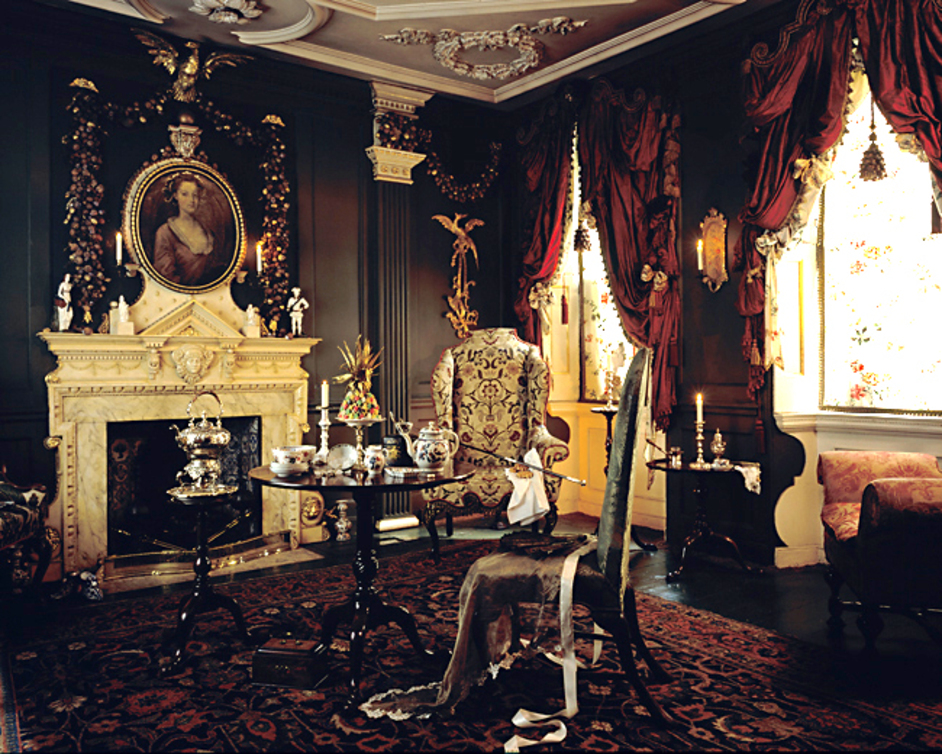
Second Floor Smoking Room - Though all is not well with the Jarvis Family, the heir is a lout and a drunkard, a spoiled rich-kid who daddy never paid attention to. The thing that is to be noted in this room is the vast number of blood-letting bowls, a common treatment for people suffering from Gout. Turned over chairs and the pungent smell of tobacco pervades. According to the myth, the young heir eventually hung himself in the attic, something that is noted in a portrait in the upstairs room - speaking of which.
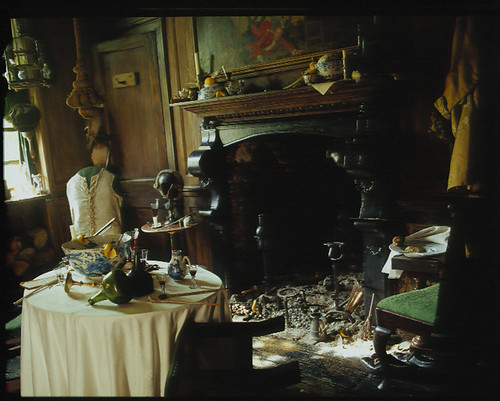


Third Floor Bedrooms - A young girls room is immediately on the left as you come up the stairs is covered with subtle notes of a broken heart. A portrait of a young man with a black ribbon tied around it, dozens of pictures of happy couples, this girl wants to be loved. Bad. The other bedroom is presumably of her mother, an eccentric who would have been a hoarder if taste had allowed. This place is lousy with blue and white china.

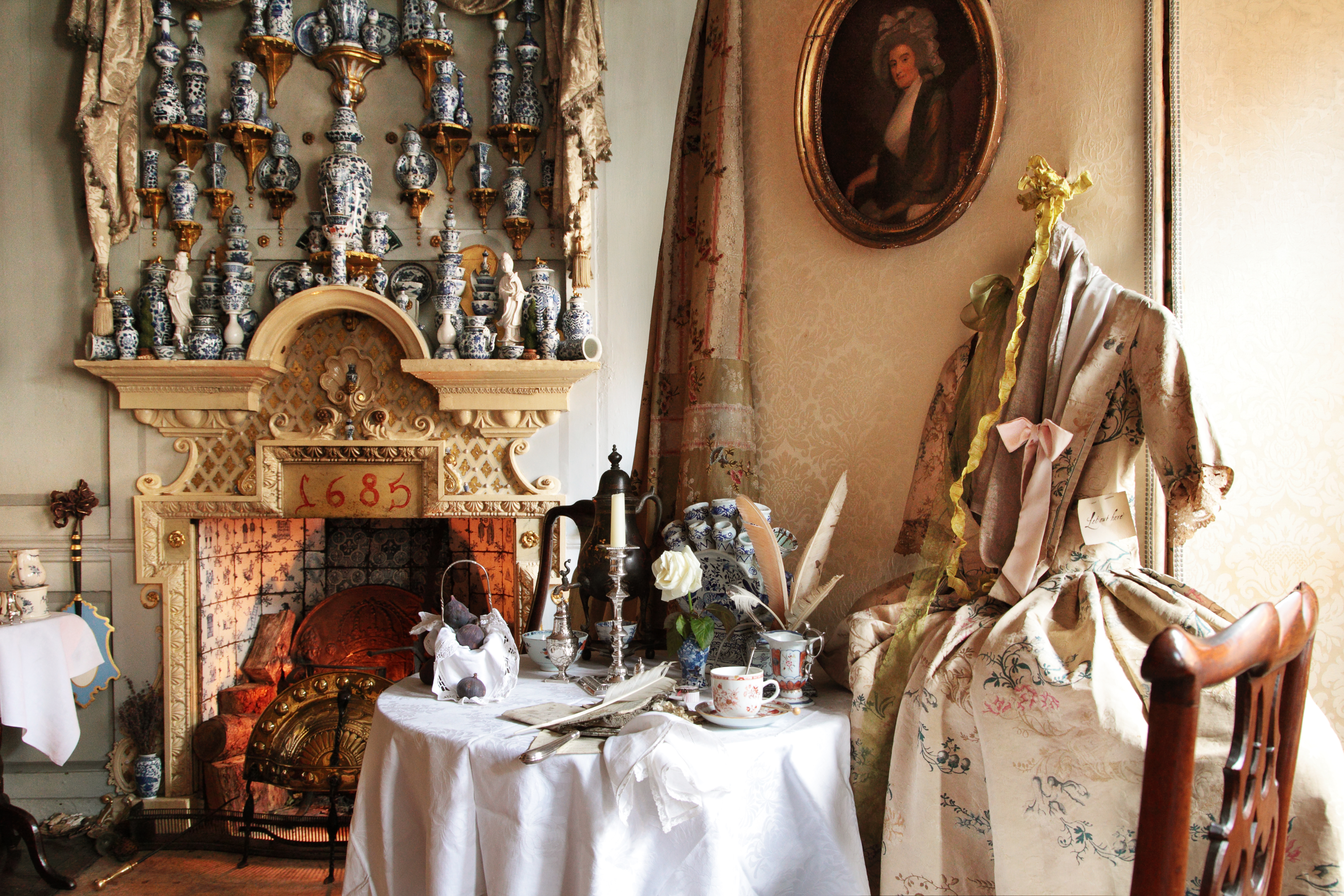

The Lodgers Rooms - But it's here where the story gets dark, fast. In an almost Dickensian turn of events, the Jarvis silk business is waning now that the industrial revolution has taken hold and they are taking in poor lodgers. Notes from "Scrooge and Marley, Esq." are posted all around, presumably these are bills for unpaid rent. This setting also makes sense as Victorian Spitalfields was the haunt of Jack the Ripper and various unsavory folks.


First Floor Parlor - Though it seems the Jervis' survive long enough to make it to the late Victorian period. The last room you enter is at the bottom of the stairs, just before you exit. Here the cult of personality that surrounds Victoria and Albert is in full swing, with over-decoration and stuffed chairs to match.


As you exit the house, you're leaving on the eve of 1912, as a subtle newspaper cutting on the wall describes. World War is upon you, and as you exit onto modernity, you know the world of the Jarvis' is over.

I liked it, though it is slightly disturbing. Though by far my favorite part was the hallway decorations. On the first floor, a magnificent candied fruit display sits delicately on a wooden table. Anyone who has been in enough museums would recognize it immediately as an objet d'art. One that, should it be on display in any other forum, would be a nice piece of pottery and nothing else. Here it is being used for its intention, and is all the more beautiful for it.

The main gist of this whole house is either you get it or you don't. A viewer will either see an intense Gesamtkunstwerk of a still lives and people just outside of sight or a total weirdo whose obsession with the past is just an uncomfortable side effect of mental illness. It's kind of up to you.

I think I get it because I understand Severs longing desire for a world not his own. More than once people have asked me why I don't want to live in the place I grew up. At the end of the day, it's because the person I was when I lived there wasn't a person I liked being: insecure and jealous, awkward and lonely. It was the liberation of all that middle-class, white bread, meet a nice boy and settle-down expectation that made me happy for the first time in years. And that liberation came in the form of constraint. Constraint by history.

History has the ability to make you feel connected to a longer tradition, even if it's one you invent, like Severs did.

Though at the end of the day, the obsession eventually consumed Severs and in the last years of his life, he sought to escape the world he created, realizing that there was no way to continue this obsession. Maybe that's the trap of reinvention, if its tied too closely to a place, then its never really yours.


Saturday, June 4, 2011

Art, Architecture, Beer, Wine, Cheese then more Wine: Retly Corm Hits Europe

Recently I discovered that I don’t necessarily have to be successful to travel well, I just need to be friends with people who are successful. This was the case last month, when my older sister (a junior CEO for a major multinational corporation) invited me on her business trip. To give our discoveries context, I feel it is necessary to give a little bit of background: it will surprise no one that I have always been a little jealous of my traveling companion.

Growing up, I was always pale, filled with angst, odd and desperate for approval. While she, at least to me, was tan, blonde, popular and envied no one.

This is the woman whom I one time asked the rhetorical question of :

“Man, I looked so good this morning and now I look crazy frumpy, does that ever happen to you?”

“No.”

Then a long pause

“I’m really pretty; those kinds of things just don’t happen to me”

Because of our clear differences we were often put into categories; Artistic and Misunderstood vs. Bubbly and Manipulative. Basically Jane Eyre vs. Emma Woodhouse.

I know I deserved no such credit, nor she such censure. Between the two, she has always been the smarter one and though we continually butted heads in our adolescence, we actually became good friends as we grew older. I became more confident and less dependant on others, while she became more sympathetic and understanding of faults. Eventually we decided not to force each other to be what the other one wanted. I was never going to be accepted by the Field Hockey Team and she was never going to care about the Battle of Thermopolis.

Keep that in mind when I force her to join me, on not one, but TWO modern art museums even though she hates them. She didn't even complain once. Long story short: she's pretty cool.

So let’s get down to it, shall we?

London: Part I Lone Ranger in a Strange Land.

Arriving at 7:00 am on Thursday after the world’s longest flight, I made the decision that should I ever have enough power to institute it, I am banning babies from international red-eye flights. I’m not sure what tragedy that baby had seen in its short life, but it was making it well known. Verbally. For 5 hours.

Perhaps it was the symptoms of exhaustion and disorientation that made the city of London seem so much more magical that morning. The sun was shining with a kind of pleasant indifference, the kind that beautiful people have, and I headed from our hotel along Hyde Park straight to the National Galleries.

Visiting an art museum is something that is usually best done after going Rogue. An art museum is a kind of secular cathedral; you need to be one with the greater forces at work. Such was the case here. Some of the highlights include:

Hogarths’ “Marriage A La Mode” which depicts the unfortunate and arranged marriage and acts as biting social commentary. I’ve mentioned Hogarth before on the Blog (While I was in Scotland) but just in case you’re not familiar with Hogarth, here’s his formula:

Plate 1- This is John. John works hard at a printer’s shop. This is John’s friend Steve. Steve is lazy and kicks dogs.

Plate 2- John is rewarded for his hard work and marries a respectable young lady. Steve says “Eff this” and goes off to the East Indies.

Plate 3- John becomes a Law Clerk. Steve dicks around with Hookers.

Plate 4- John buys an estate in the country. Steve contracts syphilis and his ugly girlfriend steals from the blind orphans.

Plate 5 – John becomes Mayor and is now the richest man in London.

Plate 6 -Steve gets beat up by his ex girlfriend’s new boyfriend and is burned in a fire only to be hung later that day.

The good are rewarded, the evil are punished. No redemption available. Maybe it’s because I’m too brassy for my own good, but the heroes of Hogarth Paintings always seem like such tools. I feel like the Villains are at least interesting, they don’t live their lives by the book (God forbid).

However, unlike the Rake’s or Harlot’s Progress paintings, Marriage A La Mode reads less like a Bad Gofus and Gallant sketch from Hilights for Kids.

It is more a tale of love of money over respect for others than a how-to guide. The young couple is really only a set of cogs in a system that is fundamentally broken. This is what Hogarth is really all about, meritocracy not mediocrity. Eventually they become the monsters society has made them, nothing more, nothing less.

There are countless other great paintings:

Velazquez- Venus at the Mirror
(Damn Girl you so fine you making me sexist, so fine crazy women want to stab you)

Van Dyck – Portrait of Charles I
(So I’m short, big friggin deal. I’m still going to rule your asses until...oh wait…dang)

Van Eyck – The Arnolfini Portrait
(maybe after you’re finished pretending to be pregnant you can get some housework done)

Titian – Bacchus and Ariadne
(Some brothers wanna play that "hard" role and tell you that the butt ain't gold, So they toss it and leave it, and I pull up quick to retrieve it)

Rubens- The Judgement of Paris
(Girls. Girls. You’re all pretty. Yeah, pretty heavy. Oh damn)

Wright – An Experiment on a Bird in an Air Pump
(Don’t worry girls, that bird stole a T.V. he deserves it)

Carravaggio – Boy Bitten by a Lizard
(Am I a metaphor for dude sex? A technical exercise on exploring the senses? Social commentary? Who knows.)

Holbien – The Ambassadors
(It’s like a magic eye, but literally a million times better)

Gainsborough – Mr. and Mrs. Andrews
(Look at all our stuff. Seriously, there’s a lot of it)

Suerat – The Bathers at Asnieres.
(In all seriousness this painting almost made me cry…It was at that point I realized I needed to eat and pee, not necessarily in that order, to become sane again)

Finally there’s Turner.

http://www.youtube.com/watch?v=Zc_zrz6j9Hw&feature=related
http://www.youtube.com/watch?v=dhICGT1gnCA

No one ever breaks your heart quite like J.M.W.Turner. There is dignity and loneliness, disrepair and nostalgia all in that kind of sad golden light. The self acknowledged end of an age. This is the most poignant in The Fighting Temmiers. Turner knows it’s only a matter of time until he and his ilk are shooed away by the hard, sharp and loud future. (I’m looking at YOU Isambard Kingdom Brunnel) But there’s no point in being mad about it. Just try and go off with a little bit of dignity. That is until John Ruskin finds stacks and stacks of porn in your house after you die. Gross.

http://www.guardian.co.uk/uk/2004/dec/29/artsandhumanities.arts

The Gallery building itself is quite imposing

Originally put up by John Nash as a (can you believe it) Parthenon of virtue through art. Eventually John Nash had his ideas stolen and built by another. As the collection expanded so did the building. Each addition feels like a complex layer added onto a strong backbone. As if to say “Me too! I’m in! Don’t Forget me.” All except one. This is of course, the addition by Venturi Scott Brown and Associates. The Sainsbury Wing, is unlike the others for obvious reasons. Firstly, it’s post-modern. And very much so.

There pulling back of the stone and making it into a curtain holding back the show is that rare combination of wit, drama and sexiness that made Venturi into a legend and is so missing from his later work. The original scheme for the addition by Ahrends, Burton and Koralek was called a "monstrous carbuncle" by the Prince of Wales. A term which is now common (apparently) for a modern building that clashes with its surroundings.

http://www.ribapix.com/image.php?i=17036&r=2&t=4&x=1

The galleries of VSBA are stark yet cozy, humble yet wry. Out of context and yet completely at home, almost like an Italian painting in a British Museum…

The next stop was the National Portrait Gallery in London. A whole 30 feet away.

Beautiful, inspiring and expected. Like a Facebook gallery of you and all your supercool friends. I feel a little bit like a stalker. Additionally there is nothing I can say about this gallery which has not been said more eloquently than Kate Beaton:

http://www.harkavagrant.com/index.php?id=167
http://www.harkavagrant.com/index.php?id=168
http://www.harkavagrant.com/index.php?id=169
http://www.harkavagrant.com/index.php?id=170

Stay tuned for the next episode:

London Part II. Birds and Serpents.