Whelp it happened, I too, like many of my architectural brethren, have been pulled as a moth to the flame to New York City. A place I never thought I would live in. Though now that I’ve signed the lease to a huge sublet in Chinatown I’m starting to get kind of excited. Stay posted bloggers. I’m sure I’ll be one of the following options.
OR

Friday, September 26, 2014

Thursday, September 4, 2014
On the Hunt
So it occurs to me that for almost a year now I have been working freelance and continuing down my path of an unusual architectural career. Don't get me wrong, I personally love the balance of designing a kitchen in the morning and writing theory/history in the evening. Though the concept of wanting things is human, and so far the things I want are those which I think any 29 year-old person wants. An apartment I don't have to share with anyone and to be successful. However, that notion of "successful" is what I'm looking to write about today.
A few months ago, I had to leave London for visa issues. Trying to find a sponsorship job was a nightmare. The search resulted in a lot of self-doubt and the pain of losing a place and people (including one person in particular) who matter so much to me. A strong anti-immigration law meant that I could not extend my visa, nor could I act as self-employed and stay in the country. I contemplated (and still am contemplating) going whole-hog and investing in a PhD in Architectural History and Theory, however my bank account told me now was not a time to do that. I won't lie, it broke my heart to leave. I'm sure I'm not the first person to lose their cool at an airport, but I may be the first to have a total break-down in a duty-free aisle. If, in the future, I've got to summon tears on a whim, it will be the image of doors closing while my East-London Love waived goodbye. Not knowing when, if ever, I could return. Long story short: it sucked. It sucked big.
Though, in true American optimism, a person has to pull themselves together and survive. Since then I've designed a couple of interiors, published a ton of articles and committed myself to work at various Museums.
More than anything, it's struck me what a strange process it is looking for an office job. If media is to be believed, most people want to escape their cubicle imprisonment wishing to be free as a bird. What they never see is the point of view from the bird, afraid that at any moment they'll plummet towards the Earth. As it stands, most of my time is taken up by informational interviews, discussing options with recruiters, drafting, entering competitions and the general malaise of having to go to baby shower after baby shower. Which brings me again, to the notion of success.
Most of the time Shower-based parties are lovely, but sometimes they can enter into darker territory. A friend's husband told me about a week ago that "You had your chance to fall in love, and now you've got to fall in line", a half-joking attempt to set me up with one of his friends "Afterall, you're getting older now, and no one wants to have kids with someone older." Dude. What.
The question is, why can't architecture be my kid? I'm not saying I wouldn't love to be a mother at some point, but for God's sake, success is not determined by whether or not I've produced progeny. I understand where these men (I hate to be sexist, but it's typically men who are this insensitive) are coming from. They've just become fathers, which totally re-adjusts priorities, but the definition of success in a post-modern world is trickier concept than I previously thought.
In this past year, the impression I've gotten from friends with children is "everyone should want what I have", rather than the impression of success as "something only a few people have that everyone wants." If success is the accomplishment of a goal, that goal has to be one that is created on a personal level. If my goal is to create architecture, discourse and design that is nuanced, intelligent and useful, then I would deem that I'm moving towards success. If the goal instead was to fulfill the expectation of passing on my genes within a time frame that, until I moved back to the US, I was completely unaware of, then, yeah, I'm not as successful as I could be. But I don't think I'm a lost cause yet.
As I told my cockney love, "I'll probably never be famous, and if I ever am, it will probably be a century after I'm dead. I'm offering you a chance to get in on the ground floor of that. With me, you could have a lifetime of struggle, hardship and rejection." He laughed "Well, that is an appealing offer, but at the end, am I just going to be a footnote?" "More than that honey, you get to be a muse."
I hate to sound like a motivational speaker, I leave that to those more sincere and Candid-esque than myself. But I will say this. Designers of the world: do you. I don't know if it's good advice, but it's the only advice I've got to give. That and know the colors that look good on your skin.
A few months ago, I had to leave London for visa issues. Trying to find a sponsorship job was a nightmare. The search resulted in a lot of self-doubt and the pain of losing a place and people (including one person in particular) who matter so much to me. A strong anti-immigration law meant that I could not extend my visa, nor could I act as self-employed and stay in the country. I contemplated (and still am contemplating) going whole-hog and investing in a PhD in Architectural History and Theory, however my bank account told me now was not a time to do that. I won't lie, it broke my heart to leave. I'm sure I'm not the first person to lose their cool at an airport, but I may be the first to have a total break-down in a duty-free aisle. If, in the future, I've got to summon tears on a whim, it will be the image of doors closing while my East-London Love waived goodbye. Not knowing when, if ever, I could return. Long story short: it sucked. It sucked big.
Though, in true American optimism, a person has to pull themselves together and survive. Since then I've designed a couple of interiors, published a ton of articles and committed myself to work at various Museums.
More than anything, it's struck me what a strange process it is looking for an office job. If media is to be believed, most people want to escape their cubicle imprisonment wishing to be free as a bird. What they never see is the point of view from the bird, afraid that at any moment they'll plummet towards the Earth. As it stands, most of my time is taken up by informational interviews, discussing options with recruiters, drafting, entering competitions and the general malaise of having to go to baby shower after baby shower. Which brings me again, to the notion of success.
Most of the time Shower-based parties are lovely, but sometimes they can enter into darker territory. A friend's husband told me about a week ago that "You had your chance to fall in love, and now you've got to fall in line", a half-joking attempt to set me up with one of his friends "Afterall, you're getting older now, and no one wants to have kids with someone older." Dude. What.
The question is, why can't architecture be my kid? I'm not saying I wouldn't love to be a mother at some point, but for God's sake, success is not determined by whether or not I've produced progeny. I understand where these men (I hate to be sexist, but it's typically men who are this insensitive) are coming from. They've just become fathers, which totally re-adjusts priorities, but the definition of success in a post-modern world is trickier concept than I previously thought.
In this past year, the impression I've gotten from friends with children is "everyone should want what I have", rather than the impression of success as "something only a few people have that everyone wants." If success is the accomplishment of a goal, that goal has to be one that is created on a personal level. If my goal is to create architecture, discourse and design that is nuanced, intelligent and useful, then I would deem that I'm moving towards success. If the goal instead was to fulfill the expectation of passing on my genes within a time frame that, until I moved back to the US, I was completely unaware of, then, yeah, I'm not as successful as I could be. But I don't think I'm a lost cause yet.
As I told my cockney love, "I'll probably never be famous, and if I ever am, it will probably be a century after I'm dead. I'm offering you a chance to get in on the ground floor of that. With me, you could have a lifetime of struggle, hardship and rejection." He laughed "Well, that is an appealing offer, but at the end, am I just going to be a footnote?" "More than that honey, you get to be a muse."
I hate to sound like a motivational speaker, I leave that to those more sincere and Candid-esque than myself. But I will say this. Designers of the world: do you. I don't know if it's good advice, but it's the only advice I've got to give. That and know the colors that look good on your skin.
Thursday, August 14, 2014
Time slips
While I find that including individual time slips with invoices to clients is completely unnecessary, I do believe that time slip descriptor regulations are logical, to keep activities associated with a project clear and trackable.
Firstly, why do I think time slips on invoices are unnecessary? Because, with almost every other industry you are not itemizing every moment of the service you are invoicing. We take down the time for our records and use, of course. And if there is a dispute over how much time is put towards a phase, THEN and only THEN should you produce the itemized list of time slips. All the client needs to focus is on is how far along in the project you are and how much they owe. I'm not saying you keep scope creep a secret. In fact I think it is a serious struggle for many firms on how you manage scope creep. Do you want your client to think you are nickel and diming them for every little design change? Certainly not, but at some point they are asking way more of you than you originally estimated and at some point that needs to be tabulated as an additional service.
Anyway, back to time slip phraseology. A coworker of mine suggested starting each time slip entry with one of a few key terms. They are: design, coordinate, meeting, detail. I think there are a few more that could be included, but I'm bit sure which word best encompasses all the meanings. You need something that covers phone calls with clients where they are expressing a concern or inquiring about a time frame or whatever. I have one client who calls me almost every day to either make a design change, request an update on structural/zoning/HARB/product estimates. If I don't log that time and bill it to him, that shit adds up fast. Anyway, so I'm thinking... Phone calls with clients could be considered coordination or meeting. But I think I like the idea of specifically noting a phone call as such because if you reference "design changes" or "coordination as directed in client phone call such and such date," then the phone call is logged there in your time slips automatically.
I find myself pondering many office management ideas and operations lately. I don't know if it is just lack of understanding on the part of the clients or lack of clarity from us, but lately it seems like clients of all financial backgrounds are scrutinizing invoices much more aggressively than it seems they should.
Random thoughts during a car ride whole typing on my phone. Please excuse typos.
Wednesday, June 4, 2014
Saturated Space: Meeting Chroma the Great: Pantone, From Chemistry ...
What's that you say? You want to read an academic paper consisting of ragging on Pantone for 20 pages? Well guess what, you're dreams are coming true.
Saturated Space: Meeting Chroma the Great: Pantone, From Chemistry ...:
http://www.saturatedspace.org/2014/06/meeting-chroma-great-pantone-from.html?spref=fb
Saturated Space: Meeting Chroma the Great: Pantone, From Chemistry ...:
http://www.saturatedspace.org/2014/06/meeting-chroma-great-pantone-from.html?spref=fb
Thursday, May 29, 2014
A Cosmic Dance of Bursting Decadence and Withheld Permissions - The Dennis Severs House
So if you're following the blog, it's no secret that East London is probably my favorite place in the world. When I moved here it kind of felt like one of those coming-of-age movies from the 90s about 'the summer that changed everything' but with way more hard liquor and a better soundtrack. And indeed, in certain parts of Shoreditch, the obnoxiousness of never-ending adolescence is still strong in the streets. Regardless - East London is where I became the person I always wanted to be: it's where I fell in love, it's where I started dying my hair and wearing clothes that fit, and against the best backdrop in the world I was finally happy: hundreds of years of history and an ever-changing landscape. This is not to say I'm immune to its flaws. If I have to walk into one more hipster bar and pay 9$ for a beer while some dingus wearing Google Glass explains why I should be doing their design work for free, I'm going to yak.
Though I'm not the only American to fall prey to the charms of Spitalfields, there have been many before me but who exceeded all collective eccentricities and definitely had more money. Was the king of the desperate romantics: Dennis Severs.
Dennis Severs had been brought up in post-war California, and while the likes of Reyner Banham were dreaming of the place-less reinvention that the West provides, Severs longed to be part of something older. After years of costume dramas on TV, Severs arrived in London in the 1970s, but found something not at all to his tastes. It was a rapidly industrializing place and the city workers were getting more encompassing by the day. Instead of accepting his disappointment and adjusting, he simply ignored the development around him and decided to live in the past. Sort of like the Amish or Japan's rejection of firearms for 300 years.
The past became Severs medium: he began by buying an authentic handsome cab and giving rides. But after his stable was demolished by developers, he needed to find another outlet. So he bought a ramshackle house at 18 Folgate Street and started to work.
He decided that he was going to invent a family of Huguenots silk merchants, their beginnings as hard working protestants to grasping decadence and further to their inevitable decline. Each room in the house was going to be a total experience, sights, smells, sounds. All in perfect silence while Severs described this fantastical history. Here's a quick recap starting from the bottom-up:
Basement Cellar - The remnants of the leper burial plot from St. Mary's Spital (hence the name: Spitalfields)

Basement Kitchen - The beginning of sensory development, in an almost Frank Lloyd Wright philosophy, he reminds the viewer that the Latin word for hearth is focus. So the fire is the axis on which the rest of the home moves (editorial note: I've always disagreed with this statement, though maybe because I've always had central heat)

First Floor Dining Room - The "Jarvis Family" (again, a complete invention by Severs) move in and are the kind of hard-working patriarchs one might expect. Food half eaten, a clean, functional, warm space filled with orders and announcements.

Second Floor Parlor - It seems a generation later, their protestant beginnings have started to give way to the Enlightenment principles of Kantian aesthetics: not a single thing should be added or removed, the room is complete.
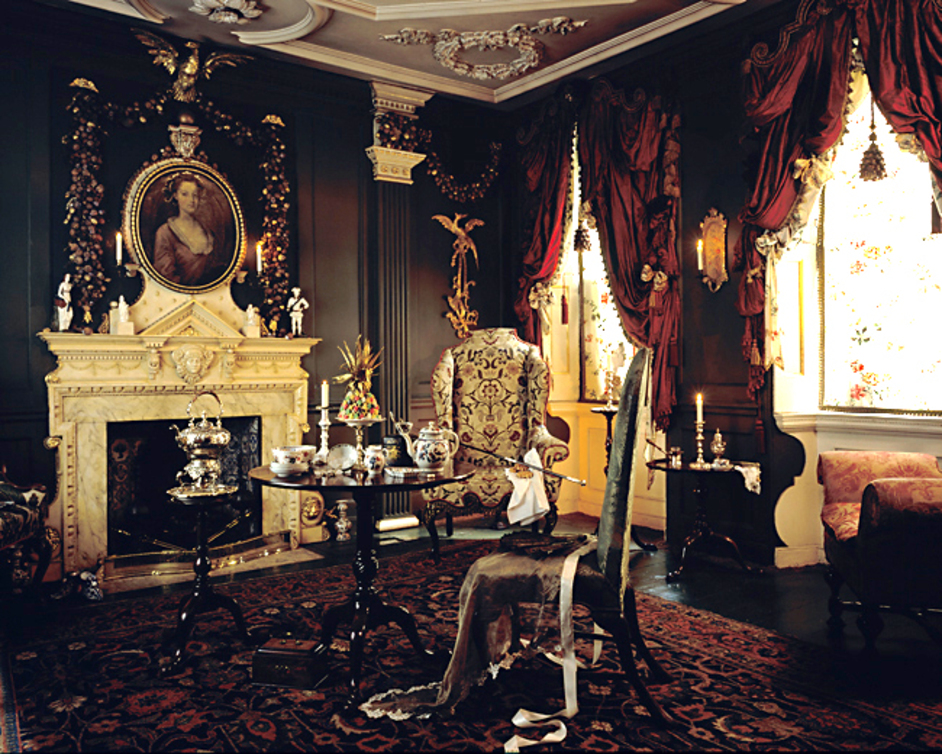
Second Floor Smoking Room - Though all is not well with the Jarvis Family, the heir is a lout and a drunkard, a spoiled rich-kid who daddy never paid attention to. The thing that is to be noted in this room is the vast number of blood-letting bowls, a common treatment for people suffering from Gout. Turned over chairs and the pungent smell of tobacco pervades. According to the myth, the young heir eventually hung himself in the attic, something that is noted in a portrait in the upstairs room - speaking of which.
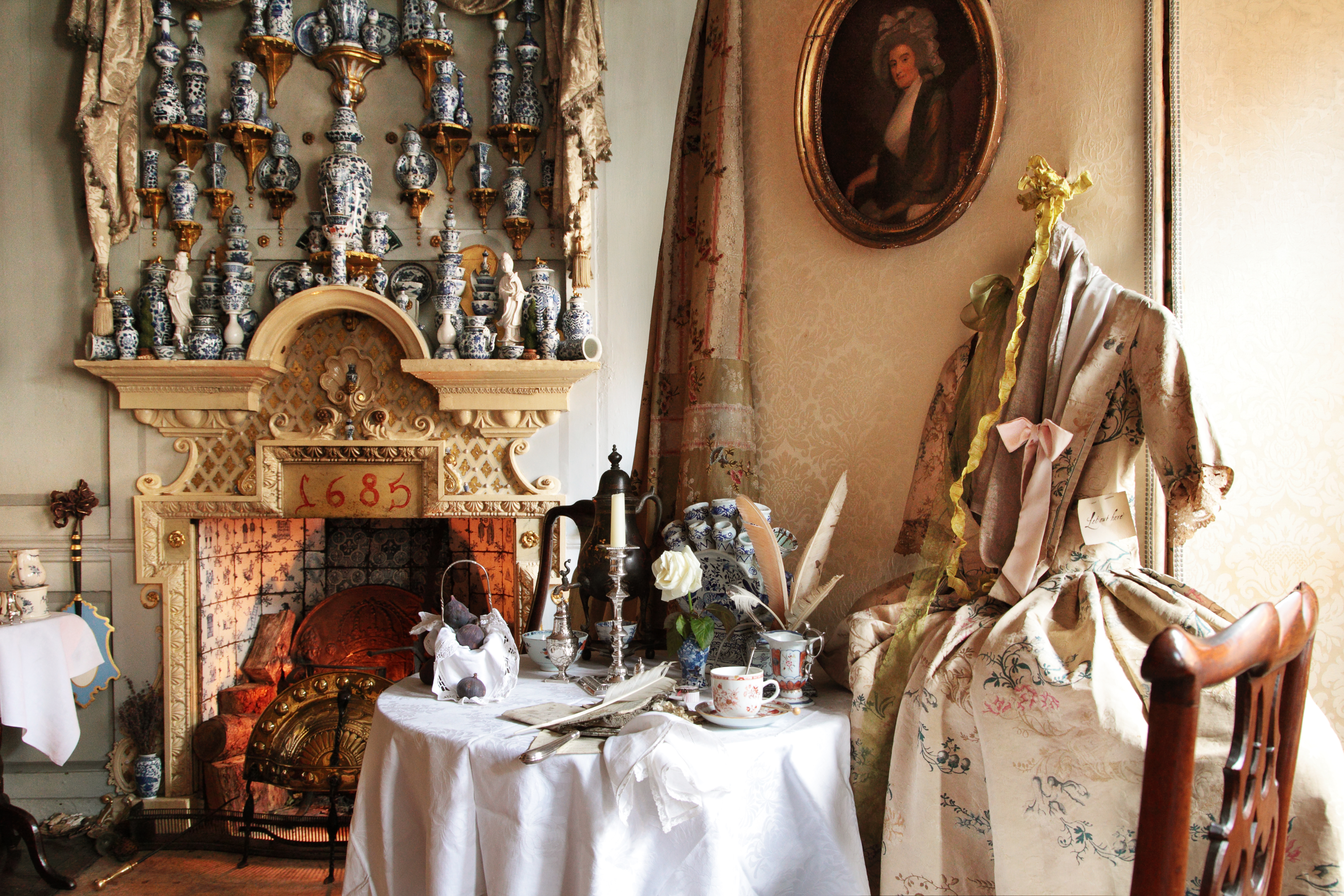
Third Floor Bedrooms - A young girls room is immediately on the left as you come up the stairs is covered with subtle notes of a broken heart. A portrait of a young man with a black ribbon tied around it, dozens of pictures of happy couples, this girl wants to be loved. Bad. The other bedroom is presumably of her mother, an eccentric who would have been a hoarder if taste had allowed. This place is lousy with blue and white china.

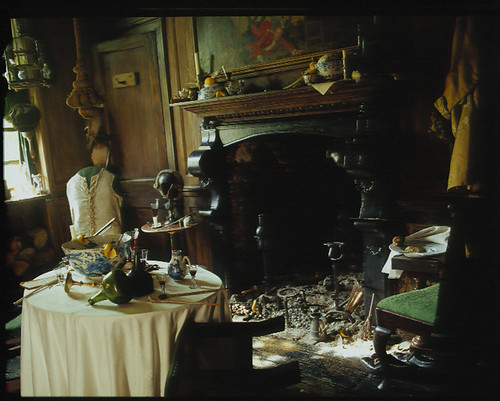
The Lodgers Rooms - But it's here where the story gets dark, fast. In an almost Dickensian turn of events, the Jarvis silk business is waning now that the industrial revolution has taken hold and they are taking in poor lodgers. Notes from "Scrooge and Marley, Esq." are posted all around, presumably these are bills for unpaid rent. This setting also makes sense as Victorian Spitalfields was the haunt of Jack the Ripper and various unsavory folks.


First Floor Parlor - Though it seems the Jervis' survive long enough to make it to the late Victorian period. The last room you enter is at the bottom of the stairs, just before you exit. Here the cult of personality that surrounds Victoria and Albert is in full swing, with over-decoration and stuffed chairs to match.

As you exit the house, you're leaving on the eve of 1912, as a subtle newspaper cutting on the wall describes. World War is upon you, and as you exit onto modernity, you know the world of the Jarvis' is over.
I liked it, though it is slightly disturbing. Though by far my favorite part was the hallway decorations. On the first floor, a magnificent candied fruit display sits delicately on a wooden table. Anyone who has been in enough museums would recognize it immediately as an objet d'art. One that, should it be on display in any other forum, would be a nice piece of pottery and nothing else. Here it is being used for its intention, and is all the more beautiful for it.
The main gist of this whole house is either you get it or you don't. A viewer will either see an intense Gesamtkunstwerk of a still lives and people just outside of sight or a total weirdo whose obsession with the past is just an uncomfortable side effect of mental illness. It's kind of up to you.
I think I get it because I understand Severs longing desire for a world not his own. More than once people have asked me why I don't want to live in the place I grew up. At the end of the day, it's because the person I was when I lived there wasn't a person I liked being: insecure and jealous, awkward and lonely. It was the liberation of all that middle-class, white bread, meet a nice boy and settle-down expectation that made me happy for the first time in years. And that liberation came in the form of constraint. Constraint by history.
History has the ability to make you feel connected to a longer tradition, even if it's one you invent, like Severs did.
Though at the end of the day, the obsession eventually consumed Severs and in the last years of his life, he sought to escape the world he created, realizing that there was no way to continue this obsession. Maybe that's the trap of reinvention, if its tied too closely to a place, then its never really yours.
Though I'm not the only American to fall prey to the charms of Spitalfields, there have been many before me but who exceeded all collective eccentricities and definitely had more money. Was the king of the desperate romantics: Dennis Severs.
Dennis Severs had been brought up in post-war California, and while the likes of Reyner Banham were dreaming of the place-less reinvention that the West provides, Severs longed to be part of something older. After years of costume dramas on TV, Severs arrived in London in the 1970s, but found something not at all to his tastes. It was a rapidly industrializing place and the city workers were getting more encompassing by the day. Instead of accepting his disappointment and adjusting, he simply ignored the development around him and decided to live in the past. Sort of like the Amish or Japan's rejection of firearms for 300 years.
The past became Severs medium: he began by buying an authentic handsome cab and giving rides. But after his stable was demolished by developers, he needed to find another outlet. So he bought a ramshackle house at 18 Folgate Street and started to work.
He decided that he was going to invent a family of Huguenots silk merchants, their beginnings as hard working protestants to grasping decadence and further to their inevitable decline. Each room in the house was going to be a total experience, sights, smells, sounds. All in perfect silence while Severs described this fantastical history. Here's a quick recap starting from the bottom-up:
Basement Cellar - The remnants of the leper burial plot from St. Mary's Spital (hence the name: Spitalfields)
Basement Kitchen - The beginning of sensory development, in an almost Frank Lloyd Wright philosophy, he reminds the viewer that the Latin word for hearth is focus. So the fire is the axis on which the rest of the home moves (editorial note: I've always disagreed with this statement, though maybe because I've always had central heat)
First Floor Dining Room - The "Jarvis Family" (again, a complete invention by Severs) move in and are the kind of hard-working patriarchs one might expect. Food half eaten, a clean, functional, warm space filled with orders and announcements.
Second Floor Parlor - It seems a generation later, their protestant beginnings have started to give way to the Enlightenment principles of Kantian aesthetics: not a single thing should be added or removed, the room is complete.
Second Floor Smoking Room - Though all is not well with the Jarvis Family, the heir is a lout and a drunkard, a spoiled rich-kid who daddy never paid attention to. The thing that is to be noted in this room is the vast number of blood-letting bowls, a common treatment for people suffering from Gout. Turned over chairs and the pungent smell of tobacco pervades. According to the myth, the young heir eventually hung himself in the attic, something that is noted in a portrait in the upstairs room - speaking of which.
Third Floor Bedrooms - A young girls room is immediately on the left as you come up the stairs is covered with subtle notes of a broken heart. A portrait of a young man with a black ribbon tied around it, dozens of pictures of happy couples, this girl wants to be loved. Bad. The other bedroom is presumably of her mother, an eccentric who would have been a hoarder if taste had allowed. This place is lousy with blue and white china.
As you exit the house, you're leaving on the eve of 1912, as a subtle newspaper cutting on the wall describes. World War is upon you, and as you exit onto modernity, you know the world of the Jarvis' is over.
I liked it, though it is slightly disturbing. Though by far my favorite part was the hallway decorations. On the first floor, a magnificent candied fruit display sits delicately on a wooden table. Anyone who has been in enough museums would recognize it immediately as an objet d'art. One that, should it be on display in any other forum, would be a nice piece of pottery and nothing else. Here it is being used for its intention, and is all the more beautiful for it.
The main gist of this whole house is either you get it or you don't. A viewer will either see an intense Gesamtkunstwerk of a still lives and people just outside of sight or a total weirdo whose obsession with the past is just an uncomfortable side effect of mental illness. It's kind of up to you.
I think I get it because I understand Severs longing desire for a world not his own. More than once people have asked me why I don't want to live in the place I grew up. At the end of the day, it's because the person I was when I lived there wasn't a person I liked being: insecure and jealous, awkward and lonely. It was the liberation of all that middle-class, white bread, meet a nice boy and settle-down expectation that made me happy for the first time in years. And that liberation came in the form of constraint. Constraint by history.
History has the ability to make you feel connected to a longer tradition, even if it's one you invent, like Severs did.
Though at the end of the day, the obsession eventually consumed Severs and in the last years of his life, he sought to escape the world he created, realizing that there was no way to continue this obsession. Maybe that's the trap of reinvention, if its tied too closely to a place, then its never really yours.
Tuesday, April 8, 2014
The Wonderful World of Architectural Writing
So I've been kind of lax in posting my other writings on the blog here.
I assure you it is not from lack of work but neither am I going to complain with my least favorite excuse: "I'm so busy". The answer is that I now share a wall with my infant niece and the lack of sleep that produces has made me all kinds of scatter-brained. But nevermind that, without further ado -

Madness and Method at St. Elizabeths
Washington D.C.’s next major addition is a department headquarters that challenges the city’s views on temporality, functionality and even irony. The site is a place of madness, method and the schemes in between; one the government both embraces and fears.
Published by 'Failed Architecture' April 2014 See the full article HERE

Next Time, Send Flowers
In this short essay, misappropriated art theory and fame are discussed in the scope of a recent tabloid obsession. A Hollywood superstar's plagerism, some bizarre skywriting and a gallery show are all clues, but who is the culprit in this crime of art theft?
Published by 'Resonance' the Architectural Association History and Critical Thinking Research Platform, March 2014 See Full Article HERE

Changing Times, Changing Designs: Council Offices Then and Now
What does the design of local government say about surrender, duty and the perceptions of power? Camden’s replacement of their Brutalist Council Office Building with a new one, gives a clue.
Published by 'Failed Architecture' January 2014 See the full article HERE

The Nothing That Consumes: How Battleship Grey Changed Design
In 1909 the Royal Navy began painting everything within grasp a vague, nothing kind of colour, one that was intended to be useful, not beautiful. Yet over 100 years later “Battleship Gray” has become the inescapable basis of almost all design and subsequently, most of the physical world. More than a post-war standard-issue metaphor for bureaucratic oppression, or a dogmatic footnote in architectural academia, it is the colour of purgatory and boredom, the promise of a future while the soul is mortgaged: doing far more for and to design that it has ever been credited for. Further, the only way to break the bonds of its oppression is to acknowledge it as fact.
Published by 'Saturated Space' Nov 2013 Read the full article HERE
There is also talk of my work being published in a book. I won't say anything more about it than I am excited and dubious.
Now if I could only devise a way to get babies to sleep through the night.
I assure you it is not from lack of work but neither am I going to complain with my least favorite excuse: "I'm so busy". The answer is that I now share a wall with my infant niece and the lack of sleep that produces has made me all kinds of scatter-brained. But nevermind that, without further ado -
Madness and Method at St. Elizabeths
Washington D.C.’s next major addition is a department headquarters that challenges the city’s views on temporality, functionality and even irony. The site is a place of madness, method and the schemes in between; one the government both embraces and fears.
Published by 'Failed Architecture' April 2014 See the full article HERE
Next Time, Send Flowers
In this short essay, misappropriated art theory and fame are discussed in the scope of a recent tabloid obsession. A Hollywood superstar's plagerism, some bizarre skywriting and a gallery show are all clues, but who is the culprit in this crime of art theft?
Published by 'Resonance' the Architectural Association History and Critical Thinking Research Platform, March 2014 See Full Article HERE
Changing Times, Changing Designs: Council Offices Then and Now
What does the design of local government say about surrender, duty and the perceptions of power? Camden’s replacement of their Brutalist Council Office Building with a new one, gives a clue.
Published by 'Failed Architecture' January 2014 See the full article HERE
The Nothing That Consumes: How Battleship Grey Changed Design
In 1909 the Royal Navy began painting everything within grasp a vague, nothing kind of colour, one that was intended to be useful, not beautiful. Yet over 100 years later “Battleship Gray” has become the inescapable basis of almost all design and subsequently, most of the physical world. More than a post-war standard-issue metaphor for bureaucratic oppression, or a dogmatic footnote in architectural academia, it is the colour of purgatory and boredom, the promise of a future while the soul is mortgaged: doing far more for and to design that it has ever been credited for. Further, the only way to break the bonds of its oppression is to acknowledge it as fact.
Published by 'Saturated Space' Nov 2013 Read the full article HERE
There is also talk of my work being published in a book. I won't say anything more about it than I am excited and dubious.
Now if I could only devise a way to get babies to sleep through the night.
Where do we begin, the Rubble or Our Sins? The Collapse of Robin Hood Gardens
So this week, as London is completely shut-down in the holidays, I decided to take a visit out to the soon to be demolished Robin Hood Gardens by the Smithsons.* Now, I actually don't live too far from the complex, (only about a 10 minute walk north) but hadn't been because, as my cockney love so elegantly put it: "Don't go down there, some of those people are right scally." But in a great continuation of earlier themes in ignoring good advice, I went anyway.
And what did I think?
I liked it a lot, that is, I liked it a lot architecturally. In another age, and with significantly more money, it might have been like the Royal Crescent in Bath. Looking at the space, it's balanced with the landscape and the details are well crafted by designers who clearly cared about what they were putting together. In the past year, I've developed a growing fondness for Brutalism, not as a factor, but as a design style with vision and specific intent. If I would summarize the space in a word it would be: Honesty.
But then again, I'm an architect and as such see the design, but not what it means.
Now that I live in the far East End, as opposed the "fashionable" East End I lived in previously (which I can no longer afford because, as it turns out, Grad School student loans are expensive) social housing, as a typology, makes sense. You've got a lot of people with kids, a lot of people looking for work, and a lot of immigrants (including myself) who need help getting a foot in the door. What doesn't make sense, though, is asking people to walk across a massive complex just to get to public transport, dark corners, visual inaccessibility and most importantly, having a big-ass depressing highway right next to a massive housing complex. It is too big to live in.
Looking at Robin Hood Gardens made me realize that as much as architecture wants to be a balm for social issues, a lot designs of social agendas are kind of dickish.
The word I'll use here which I am loathe to use is "Community". I hate the word "community" in design because it's often just a flowery hipster way of saying "the natives", that is, poor people. It's an upper middle class way of classifying anything other than an organic farmers market and craft fair is somehow not enough. In a way, current social housing developments are at their most obnoxious when schemes are phrased as "fostering community" as if community was an orphan, lost in a system. What these kinds of statements imply is that there isn't a group of people who have a way of relating to each other already.
They do. They live in the same part of town. Is it always a shining beacon of connection and tolerance? No. God No. But assuming that some walls and windows are going to fix something like three generations of not having enough money is silly.
The Smithsons themselves had similar feelings about their work by the 1990s. Basically saying the problem with Robin Hood Gardens was not the architecture, it was the people in it. When I first heard these statements, I was shocked, I mean the basic understanding of contemporary architecture is that can make people better. But what makes people better is so far beyond architecture it's almost scary. For example, right now in Poplar, the private housing industry is moving in with full force. Kicking people out of the Goldfinger's Balfron Tower and building complexes for Canary Wharf finance workers at indestructible speed.
What really helps people is giving them skills as children, jobs as adults and not telling them that's not enough. Architecture can't really do this, it only provides the setting. It doesn't mean the settings shouldn't try to be sustainable, accessible and, well, beautiful but asking architects to solve all the problems with their trade isn't possible. Though, asking architects not to be idealistic is like asking a fish not to swim. It's just the profession.
I think that's why social design is so fascinating, it's a rock and a hard place of intent and outcome. I guess, architects, keep trying. And yet, no Architects are not Mother Theresa, you're just a person with an idea to change the setting of a hard life for people in a city that doesn't want them anymore.
Long Story Short: Someone in 15 years is going to write a thesis about how Robin Hood Gardens was an amazing bit of architecture and will never have consulted anyone who actually lived there. Calling it now.
*I have to apologize for not having my own pictures, my camera decided it was going to die this week. But when I get it fixed I'll be sure to put more up.
And what did I think?
I liked it a lot, that is, I liked it a lot architecturally. In another age, and with significantly more money, it might have been like the Royal Crescent in Bath. Looking at the space, it's balanced with the landscape and the details are well crafted by designers who clearly cared about what they were putting together. In the past year, I've developed a growing fondness for Brutalism, not as a factor, but as a design style with vision and specific intent. If I would summarize the space in a word it would be: Honesty.
But then again, I'm an architect and as such see the design, but not what it means.
Now that I live in the far East End, as opposed the "fashionable" East End I lived in previously (which I can no longer afford because, as it turns out, Grad School student loans are expensive) social housing, as a typology, makes sense. You've got a lot of people with kids, a lot of people looking for work, and a lot of immigrants (including myself) who need help getting a foot in the door. What doesn't make sense, though, is asking people to walk across a massive complex just to get to public transport, dark corners, visual inaccessibility and most importantly, having a big-ass depressing highway right next to a massive housing complex. It is too big to live in.
Looking at Robin Hood Gardens made me realize that as much as architecture wants to be a balm for social issues, a lot designs of social agendas are kind of dickish.
The word I'll use here which I am loathe to use is "Community". I hate the word "community" in design because it's often just a flowery hipster way of saying "the natives", that is, poor people. It's an upper middle class way of classifying anything other than an organic farmers market and craft fair is somehow not enough. In a way, current social housing developments are at their most obnoxious when schemes are phrased as "fostering community" as if community was an orphan, lost in a system. What these kinds of statements imply is that there isn't a group of people who have a way of relating to each other already.
They do. They live in the same part of town. Is it always a shining beacon of connection and tolerance? No. God No. But assuming that some walls and windows are going to fix something like three generations of not having enough money is silly.
The Smithsons themselves had similar feelings about their work by the 1990s. Basically saying the problem with Robin Hood Gardens was not the architecture, it was the people in it. When I first heard these statements, I was shocked, I mean the basic understanding of contemporary architecture is that can make people better. But what makes people better is so far beyond architecture it's almost scary. For example, right now in Poplar, the private housing industry is moving in with full force. Kicking people out of the Goldfinger's Balfron Tower and building complexes for Canary Wharf finance workers at indestructible speed.
What really helps people is giving them skills as children, jobs as adults and not telling them that's not enough. Architecture can't really do this, it only provides the setting. It doesn't mean the settings shouldn't try to be sustainable, accessible and, well, beautiful but asking architects to solve all the problems with their trade isn't possible. Though, asking architects not to be idealistic is like asking a fish not to swim. It's just the profession.
I think that's why social design is so fascinating, it's a rock and a hard place of intent and outcome. I guess, architects, keep trying. And yet, no Architects are not Mother Theresa, you're just a person with an idea to change the setting of a hard life for people in a city that doesn't want them anymore.
Long Story Short: Someone in 15 years is going to write a thesis about how Robin Hood Gardens was an amazing bit of architecture and will never have consulted anyone who actually lived there. Calling it now.
*I have to apologize for not having my own pictures, my camera decided it was going to die this week. But when I get it fixed I'll be sure to put more up.
Subscribe to:
Posts (Atom)