and to think the Corbster wanted to tear it down.

Tuesday, July 31, 2012

Wednesday, July 25, 2012

Monday, July 23, 2012
IDP - Experience Reporting
It has been far too long since I last posted, so I thought I would put at least SOMETHING in here, since nothing more meaningful has come to mind in the past few months. Although, maybe I should make some posts about the improvements to my apartment.... more on that another time.
Anyway, so as you may have noticed, NCARB has revamped the e-EVR system, and now I believe it is just called "online reporting," or something non-acronymninal. Before they even had online reporting, you filed by paper. Well, my story starts then.
Circa 2007, I submitted my very first experience report to NCARB via the mail. I logged all of my summer intern hours in this manner. The following summer, NCARB launched their new online reporting system, e-EVR, where you had the option to submit experience reports online, or still through the mail. Naturally, I preferred the quicker, easier, online method to paper and pencil. I created my account, saw that my previous summer's experience was appropriately logged, and filled out a new experience log. Upon submitting the new experience, my employer was prompted to create an account, which he did, and the system worked flawlessly thereafter.
Circa 2009, I gain fulltime employment elsewhere, and thus create a new employer in my NCARB record and start using new supervisors to approve experience. Sometime in late 2011 or early 2012, NCARB decides to revamp or streamline or simplify (whichever catchphrase was appropriate for the time) the online reporting system. And now you can ONLY submit experience online (previously NCARB was accepting paper or online experience reports). Supervisors must create usernames to affiliate with their supervisor accounts (previously they would access using their email addresses as "usernames.") This seemed to work out fine at this employer.
2012, I change employment back to the firm I interned in the summers with. As stated above, at this firm I had submitted first using paper, second using e-EVR, and now attempted to submit a third report using the streamlined reporting system. When my supervisor was prompted to create a username, somehow it created a new account for him separate from my experience report, which has since been sitting idly unapproved. He isn't even able to see my account information from his profile, which did not used to be the case.
With the new exclusively online reporting system, I am now able to select the "employer" account that was created for my paper experience report. I have done this and added my current supervisor as the "new supervisor." I am hoping this will circumvent the need for me to reach out to NCARB again for help. While NCARB can help you out and get you what they need, they are very difficult to get into that position (i.e. email chains, on hold, etc.).
I apologize that I must pollute the internet with these rants. I anticipate 0 hits on this, but still at least I ended my posting drought!
I'll let you know how my situation pans out tomorrow (if my supervisor received the notification or if I have to call NCARB), as I'm certain you're biting your nails in anticipation!
Anyway, so as you may have noticed, NCARB has revamped the e-EVR system, and now I believe it is just called "online reporting," or something non-acronymninal. Before they even had online reporting, you filed by paper. Well, my story starts then.
Circa 2007, I submitted my very first experience report to NCARB via the mail. I logged all of my summer intern hours in this manner. The following summer, NCARB launched their new online reporting system, e-EVR, where you had the option to submit experience reports online, or still through the mail. Naturally, I preferred the quicker, easier, online method to paper and pencil. I created my account, saw that my previous summer's experience was appropriately logged, and filled out a new experience log. Upon submitting the new experience, my employer was prompted to create an account, which he did, and the system worked flawlessly thereafter.
Circa 2009, I gain fulltime employment elsewhere, and thus create a new employer in my NCARB record and start using new supervisors to approve experience. Sometime in late 2011 or early 2012, NCARB decides to revamp or streamline or simplify (whichever catchphrase was appropriate for the time) the online reporting system. And now you can ONLY submit experience online (previously NCARB was accepting paper or online experience reports). Supervisors must create usernames to affiliate with their supervisor accounts (previously they would access using their email addresses as "usernames.") This seemed to work out fine at this employer.
2012, I change employment back to the firm I interned in the summers with. As stated above, at this firm I had submitted first using paper, second using e-EVR, and now attempted to submit a third report using the streamlined reporting system. When my supervisor was prompted to create a username, somehow it created a new account for him separate from my experience report, which has since been sitting idly unapproved. He isn't even able to see my account information from his profile, which did not used to be the case.
With the new exclusively online reporting system, I am now able to select the "employer" account that was created for my paper experience report. I have done this and added my current supervisor as the "new supervisor." I am hoping this will circumvent the need for me to reach out to NCARB again for help. While NCARB can help you out and get you what they need, they are very difficult to get into that position (i.e. email chains, on hold, etc.).
I apologize that I must pollute the internet with these rants. I anticipate 0 hits on this, but still at least I ended my posting drought!
I'll let you know how my situation pans out tomorrow (if my supervisor received the notification or if I have to call NCARB), as I'm certain you're biting your nails in anticipation!
Wednesday, July 18, 2012
Tiptoe through the Tulips with Mies
So currently my house is somewhere between the minimalist De Stijl designs (empty and full of bright colors) and, how can I accurately put this, a garbage can (all my junk is piled into a corner). It has been said that if you want peace, you must prepare for war. Similarly, if I want to move out of this house, I must prepare to spend the rest of my life as a hoarder. 3. 3 copies of Zoolander. Who needs that many? No one, That's who.
But I digress.
In the process of boxing up the books, I was reminded of the good reads that have taken place during the 3 years I've lived here. So here - because you didn't ask for it - are my top ten favorite design books (today. right now.)
In the hope of not being too anecdotal I'm just going to put gifs down to sum up how I felt when I first read each of these books.
Why? Because it's the Internet.

#10) Phenomenology of Perception - Maurice Merleau-Ponty

#9) A Good Chair is A Good Chair - Donald Judd

#8) The Ice Palace that Melted Away - Bill Stumpf

#7) Architecture: Form, Space, Order - Francis D.K. Ching

#6) S,M,L,XL - Rem Koolhaas

#5) The Architecture of Happiness - Alain De Botton

#4) Philip Johnson: Life and Work - Franz Schulze

#3) History of the Future - Donna Goodman

#2) Complexity and Contradiction in Architecture - Robert Venturi

#1) 101 things you learn in Architecture School - Matthew Fredrick

Honorable Mention: Theorizing a New Agenda for Architecture: An Anthology of Architectural Theory 1965-1995 - Kate Nesbitt (technically a 'Best Of')
How about you guys? What were are your favorite design books?
Thanks to Whatshouldwecallme for the gifs.
But I digress.
In the process of boxing up the books, I was reminded of the good reads that have taken place during the 3 years I've lived here. So here - because you didn't ask for it - are my top ten favorite design books (today. right now.)
In the hope of not being too anecdotal I'm just going to put gifs down to sum up how I felt when I first read each of these books.
Why? Because it's the Internet.

#10) Phenomenology of Perception - Maurice Merleau-Ponty

#9) A Good Chair is A Good Chair - Donald Judd

#8) The Ice Palace that Melted Away - Bill Stumpf

#7) Architecture: Form, Space, Order - Francis D.K. Ching

#6) S,M,L,XL - Rem Koolhaas

#5) The Architecture of Happiness - Alain De Botton

#4) Philip Johnson: Life and Work - Franz Schulze

#3) History of the Future - Donna Goodman

#2) Complexity and Contradiction in Architecture - Robert Venturi

#1) 101 things you learn in Architecture School - Matthew Fredrick

Honorable Mention: Theorizing a New Agenda for Architecture: An Anthology of Architectural Theory 1965-1995 - Kate Nesbitt (technically a 'Best Of')
How about you guys? What were are your favorite design books?
Thanks to Whatshouldwecallme for the gifs.
Sunday, July 1, 2012
New Orleans Part IV: How the Other Half Lives
We've got a lot to cover so let's dive right on in shall we?
The Plantations
There is a sense of romance when one talks about the "Old South". The finery, the culture, the dresses, the balls it's all very charming. However, we can never forget that all this luxury was built off the back of hypocrisy and slavery. Now, technically, Louisiana was not part of the "Old South" as it was not a state during the Revolutionary War, it was more correctly part of the "Antebellum South" which was prominent during the four score and seven or so years between the Revolutionary War and the Civil War. On our trip up the river, we drove by several fine homes, but for the sake of time, let's look at two. Which are:
Oak Alley Plantation and Laura Plantation.
Let's start with the grander "Oak Alley"
 The
trees of Oak Alley were present long before the house was built in 1837 as the trees are expected to be about 300 years old. The
stately home was constructed via the funding of Jacques Telesphore
Roman for his wife Celina.
The
trees of Oak Alley were present long before the house was built in 1837 as the trees are expected to be about 300 years old. The
stately home was constructed via the funding of Jacques Telesphore
Roman for his wife Celina.
Celina's father was Gilbert Joseph Pilie a noted architect and probable designer of the plantation. While Jacques had been unofficially dubbed "The Sugar King" of New Orleans, he died about 10 years after the house construction and despite marital woes, left the plantation in the care of his wife. It is important to note that Celina was as bad at business as she was good at throwing parties. Nearing bankruptcy in 1859, the eldest son, Henri Roman took control of the property, but by then they were too deep in debt to turn it around. Before long the union soldiers came down the bayou and the Romans were forced to sell their fine and financially unsustainable home.
It was left in disrepair until it was bought and restored in the 1920s.
The architecture of it is just phenomenal. It's one of those places that's hard to describe why it works, it just does. Nature does not build in straight lines, but somehow this places feels so natural. As far as the design goes, it's a perfect balance of natural elements and man-made possession of landscape. It's real purdy.
The second plantation we will look at is the Laura Plantation.

Unlike Oak Alley, Laura stayed firmly in the hands of the same family since it's construction in the early 1800s. That is until the last owner, Laura Locoul Gore (the fourth owner in a direct line of succession) gave it up to move to St. Louis. The architecture is clearly much more Creole and Caribbean based than that of Oak Alley. The colors, the decoration and the functionality are much more condensed, much less focused on entertaining. Like Oak Alley, the kitchen is off to the side to take away from the heat, practical and interesting flow-wise.
However, Laura Plantation is clearly a working house, vs. Oak Alley which is very much about showing off. This is most clearly evident by the reception halls. In Oak Alley you feel you have arrived, at Laura, it is as if you have always been.
While there was a sort of tragic element to the fate of the Roman family, I have to say I was removed from that pity for the main antagonist figure of the Laura plantation, Elizabeth Locoul.
 Elizabeth
was forced into ownership of the plantation when we was young, still
very much a teenager. In part due to the culture around her as well as
the responsibility thrust upon her at such a young age, she became a desensitized bully
especially with the enslaved people on her land. She bought female
slaves for breeding purposes, tried to break up families (which at the
time was against French law, but not American law) and had at least one of her
slaves branded on the forehead for trying to escape. It was these ugly
tactics that, while keeping the plantation profitable, convinced her
grand daughter, Laura, that she wanted nothing to do with running a
plantation. Laura abdicated her duty in 1891 and sold the lot. In her
later years, Laura wrote a book about her memories of growing up on a
Creole Plantation. It's a pretty good read if you're interested. Find it here
Elizabeth
was forced into ownership of the plantation when we was young, still
very much a teenager. In part due to the culture around her as well as
the responsibility thrust upon her at such a young age, she became a desensitized bully
especially with the enslaved people on her land. She bought female
slaves for breeding purposes, tried to break up families (which at the
time was against French law, but not American law) and had at least one of her
slaves branded on the forehead for trying to escape. It was these ugly
tactics that, while keeping the plantation profitable, convinced her
grand daughter, Laura, that she wanted nothing to do with running a
plantation. Laura abdicated her duty in 1891 and sold the lot. In her
later years, Laura wrote a book about her memories of growing up on a
Creole Plantation. It's a pretty good read if you're interested. Find it here
Sadly, the home was damaged by fire in 2004 and repairs have not yet been made to restore it. Despite this, I would recommend taking a tour of it to see how different it is for all the other plantations in the area.
The Garden District
Moving closer to the city, we can find ourselves in the Garden District. This part of town is for the more suburban set. When you have lots of money, but don't want the remoteness of a plantation, nor the pressures of a house in the Quarter, which is all code for, the Americans wanted it. Many of the homes are what you would consider to be "Victorian" however, unlike the Victorian homes in Boston or Denver, it's just too hot to have the layering affect that mansions of that time were so famous for. Instead, the Garden District houses combine the best of the creole row homes, especially in regards to the porches, with the basics of Victorian architecture. As a result, the houses are large and open. Also, they are frequently adjacent to huge gardens, which gives the district it's name.
The best way to see this neighborhood is by street car. Here are some examples of the kind of houses you're likely to find in this part of town.


While touring, we were able to stop by the The Columns Hotel which is a bed and breakfast. Staying there was out of our price range, but tea in Albertine room was not.

While we were there, people brought up about five times that the house is where the movie 'Pretty Baby' was filmed. Maybe I'm an uncultured closed minded plebeian but that movie gives me the creeps. The straight up Game of Thrones creeps.
Why? Well, here's the trailer.
Gross.
Secondly, this is the Garden District, Storyville is on the other side of town, just saying. But if you're into sordid histories, Storyville is for you. It's one of those "if you're going to do that sort of thing, could you do it over there" type places.
While we're here, I know it's technically not part of the Garden District, but it was part of our Trolley Line so let's cover it.
One of my favorites of the City: The Piazza D'Italia.

In 1970s the leaders of the Italian Population of New Orleans sought a monument to honor their contribution to the Crescent City. In 1974 former Dean of the Yale School of Architecture, Charles Moore took the bait and designed the most pop of pop art, the most post-modern thing ever: The Piazza D'Italia. The Piazza had a rough start: as soon as it was completed and getting settled into the city, there was a drop in the interest of domestic oil production which meant that the community that surrounded it withered. It was almost lost as a "Post Modern Ruin" until a renovation in 2003-2004 by the Lowes Hotel Company.
I was surprised not only by how much I liked it, but also how well it was crafted. The jokes are perfectly timed:
-Architect Head Sculpture spits water onto the viewer
-The columns are just for show
-Flying buttress for some reason
-NEON!
-It is literally a map of Italy
There have always been mixed feelings about post-modernism in architecture. I had a professor in college who refused to even say the name James Wines because it caused too much controversy. On the one side some architects will note that Post-Modernism is a cheap shot, an easy out, a way of mocking the beliefs of others while contributing nothing yourself.

However, if you like Post-modernism, you see it as a witty, charming, tongue-in-cheek way of seeing the world. It doesn't always have to be significant to be meaningful, sometimes it can just be silly and still resonate with the viewer. Po-Mo moments like the Piazza D'Italia, are like the fool in King Lear, it's garish and loud but sometimes the jokes can more accurately describe the situation than the stone faced report.
I guess the best way to describe the Piazza's appeal is with this metaphor:

is kind of like:

but more sophisticated. So really it's the most like this:
and now to totally switch gears....
The Lower Ninth Ward:
In late August of 2005 a force of unprecedented impact struck the coast of the Southern United States with the heedless determination of a wild beast, destroying everything man and God had wrought there. The impact was undeniable, the blame for the aftermath was shoved and passed from person to person, agency to agency, derision infectious and despair insurmountable.

Hurricane Katrina is now as woven into the fabric of New Orleans as much as any other siginificant portion of their history. The haunted memories of long since past invasions, deadly plagues and all consuming fires were in one fell swoop eclipsed and washed away by the storm. However, seven years later, we see what makes people fall in love with New Orleans. It is not only the music, the color, the passion; it is the determination within its' people. They survive, and always will.
This is not to say that the problem is solved: "Mission Accomplished", far from it in fact. However, it does afford us an opportunity to look at the Ninth ward then and now.
Prior to 2005, the Ninth ward was famous for it's characteristic abundance of shotgun houses. Originally the area had been plantation land which was then adapted into military housing related to the Jackson Barracks (circa 1830). The neighborhood slowly grew over until it was as much part of New Orleans as the Garden District or the French Quarter. What held the water back in this area (as we mentioned earlier, most of the city is below sea level), was a series of levees along the adjacent canals.
One of these levees had broken during Hurricane Betsy in 1965, the damage from this was monumental. It was in reaction to this storm that President L.B. Johnson stated on his visit to oversee the damage: "I am here because I want to see with my own eyes what the unhappy alliance of wind and water have done to this land and to its good people." This visit prompted the Flood Control Act of 1965 which resulted in the design and maintenance of the levees being handed to the Army Corps of Engineers.

When Katrina hit, several levees broke, and despite the mandatory evacuation of the area, the storm resulted in the death of over 1600 people and billions of dollars worth of damage. I am unfit to properly categorize what this meant to the city as a whole as the aftermath is both measurable and immeasurable. You can put a price on a house, but what about a life? For further information I would recommend Chris Rose's 1 Dead in Attic

The immediate response was to give those displaced temporary shelter, which turned out to create even more problems, as some of the poorly constructed trailers were laced with toxic chemicals, creating severe health risks.
In the years following the disaster and its aftermath, a series of sustainability friendly non-profits started drawing its attention to New Orleans, in particular the Lower Ninth Ward, where the damage had been greatest. Including but not exclusive to, LowerNine, Habitat for Humanity, and most famously, Make it Right. Most people are acquainted with Make it Right as one of their spokespersons is an almost universally recognizable figure. That's right.

Come on. We all know it's Brad Pitt:

It's an example of using your celebrity for good and as glibly as it portrays the sometimes shallow reasons for supporting charity, let's use it as a means to an end. I mean, at the end of the day, who are you going to give money to:
 --This guy.
Or
 ---- This guy.
The correct answer is both of these dudes. Because they both support worthy causes.
However, while Jimmy Carter's outfit is typically more homogeneous, Make it Right has the advantage of celebrity and with that in mind arranged for some of the best architects in the world to design their homes. (Click on the names to see what they are most famous for).
Shigeru Ban
 Hitoshi Abe
 Bild
Bild
 Frank Gehry

Yes, each one is a fascinating take on what a shotgun house lot can allow for. Clearly crafted by masters of the trade, creole influences, contemporary technology, functionality and just the right amount of ego. I am excited to see how they age as well.
When we first got to New Orleans I was especially interested in seeing the Make it Right houses as I had read so much about them. However, I was lost as to how to find them, as no addresses were listed on any website. This reminded me of the paradox of architectural interest, especially when it comes to residential works: on one side, you are curious about the object as an aesthetic piece, on the other, these are people's homes and you should respect their privacy. There in lies the darker side of celebrity endorsement, people are interested in helping, but they also want to see the result and take their share of pride.
While I did find the streets that the Make it Right houses were located on, I will not post it here. The important thing is that, should you want to see them, you should drive the whole area to see the place and also probably donate to the cause of rebuilding it.

The other interesting side of this development is the aging that has taken place thus far. On one end of the spectrum are the Make it Right houses that embrace nature, on the other, is the consuming methods of Nature itself. With the sharp decrease in population (about 1/2 from 2000 to 2010 according to the census) many places have been abandoned, leading them to be reclaimed by selfish nature of plants and man. For more information on this phenomenon, see point and counterpoint.
Conclusion:
New Orleans, city of music, dark sides, light sides and everything in between. She is a romantic survivor, she is Carmen, you will love her, she will leave you broken hearted but you can never blame her for it. She is not to be trusted and always to be adored.
The Plantations
There is a sense of romance when one talks about the "Old South". The finery, the culture, the dresses, the balls it's all very charming. However, we can never forget that all this luxury was built off the back of hypocrisy and slavery. Now, technically, Louisiana was not part of the "Old South" as it was not a state during the Revolutionary War, it was more correctly part of the "Antebellum South" which was prominent during the four score and seven or so years between the Revolutionary War and the Civil War. On our trip up the river, we drove by several fine homes, but for the sake of time, let's look at two. Which are:
Oak Alley Plantation and Laura Plantation.
Let's start with the grander "Oak Alley"

Celina's father was Gilbert Joseph Pilie a noted architect and probable designer of the plantation. While Jacques had been unofficially dubbed "The Sugar King" of New Orleans, he died about 10 years after the house construction and despite marital woes, left the plantation in the care of his wife. It is important to note that Celina was as bad at business as she was good at throwing parties. Nearing bankruptcy in 1859, the eldest son, Henri Roman took control of the property, but by then they were too deep in debt to turn it around. Before long the union soldiers came down the bayou and the Romans were forced to sell their fine and financially unsustainable home.
It was left in disrepair until it was bought and restored in the 1920s.
The architecture of it is just phenomenal. It's one of those places that's hard to describe why it works, it just does. Nature does not build in straight lines, but somehow this places feels so natural. As far as the design goes, it's a perfect balance of natural elements and man-made possession of landscape. It's real purdy.
The second plantation we will look at is the Laura Plantation.

Unlike Oak Alley, Laura stayed firmly in the hands of the same family since it's construction in the early 1800s. That is until the last owner, Laura Locoul Gore (the fourth owner in a direct line of succession) gave it up to move to St. Louis. The architecture is clearly much more Creole and Caribbean based than that of Oak Alley. The colors, the decoration and the functionality are much more condensed, much less focused on entertaining. Like Oak Alley, the kitchen is off to the side to take away from the heat, practical and interesting flow-wise.
However, Laura Plantation is clearly a working house, vs. Oak Alley which is very much about showing off. This is most clearly evident by the reception halls. In Oak Alley you feel you have arrived, at Laura, it is as if you have always been.
While there was a sort of tragic element to the fate of the Roman family, I have to say I was removed from that pity for the main antagonist figure of the Laura plantation, Elizabeth Locoul.

Sadly, the home was damaged by fire in 2004 and repairs have not yet been made to restore it. Despite this, I would recommend taking a tour of it to see how different it is for all the other plantations in the area.
The Garden District
Moving closer to the city, we can find ourselves in the Garden District. This part of town is for the more suburban set. When you have lots of money, but don't want the remoteness of a plantation, nor the pressures of a house in the Quarter, which is all code for, the Americans wanted it. Many of the homes are what you would consider to be "Victorian" however, unlike the Victorian homes in Boston or Denver, it's just too hot to have the layering affect that mansions of that time were so famous for. Instead, the Garden District houses combine the best of the creole row homes, especially in regards to the porches, with the basics of Victorian architecture. As a result, the houses are large and open. Also, they are frequently adjacent to huge gardens, which gives the district it's name.
The best way to see this neighborhood is by street car. Here are some examples of the kind of houses you're likely to find in this part of town.


While touring, we were able to stop by the The Columns Hotel which is a bed and breakfast. Staying there was out of our price range, but tea in Albertine room was not.

While we were there, people brought up about five times that the house is where the movie 'Pretty Baby' was filmed. Maybe I'm an uncultured closed minded plebeian but that movie gives me the creeps. The straight up Game of Thrones creeps.
Why? Well, here's the trailer.
Gross.
Secondly, this is the Garden District, Storyville is on the other side of town, just saying. But if you're into sordid histories, Storyville is for you. It's one of those "if you're going to do that sort of thing, could you do it over there" type places.
While we're here, I know it's technically not part of the Garden District, but it was part of our Trolley Line so let's cover it.
One of my favorites of the City: The Piazza D'Italia.

In 1970s the leaders of the Italian Population of New Orleans sought a monument to honor their contribution to the Crescent City. In 1974 former Dean of the Yale School of Architecture, Charles Moore took the bait and designed the most pop of pop art, the most post-modern thing ever: The Piazza D'Italia. The Piazza had a rough start: as soon as it was completed and getting settled into the city, there was a drop in the interest of domestic oil production which meant that the community that surrounded it withered. It was almost lost as a "Post Modern Ruin" until a renovation in 2003-2004 by the Lowes Hotel Company.
I was surprised not only by how much I liked it, but also how well it was crafted. The jokes are perfectly timed:
-Architect Head Sculpture spits water onto the viewer
-The columns are just for show
-Flying buttress for some reason
-NEON!
-It is literally a map of Italy
There have always been mixed feelings about post-modernism in architecture. I had a professor in college who refused to even say the name James Wines because it caused too much controversy. On the one side some architects will note that Post-Modernism is a cheap shot, an easy out, a way of mocking the beliefs of others while contributing nothing yourself.

However, if you like Post-modernism, you see it as a witty, charming, tongue-in-cheek way of seeing the world. It doesn't always have to be significant to be meaningful, sometimes it can just be silly and still resonate with the viewer. Po-Mo moments like the Piazza D'Italia, are like the fool in King Lear, it's garish and loud but sometimes the jokes can more accurately describe the situation than the stone faced report.
I guess the best way to describe the Piazza's appeal is with this metaphor:

is kind of like:

but more sophisticated. So really it's the most like this:
and now to totally switch gears....
The Lower Ninth Ward:
In late August of 2005 a force of unprecedented impact struck the coast of the Southern United States with the heedless determination of a wild beast, destroying everything man and God had wrought there. The impact was undeniable, the blame for the aftermath was shoved and passed from person to person, agency to agency, derision infectious and despair insurmountable.

Hurricane Katrina is now as woven into the fabric of New Orleans as much as any other siginificant portion of their history. The haunted memories of long since past invasions, deadly plagues and all consuming fires were in one fell swoop eclipsed and washed away by the storm. However, seven years later, we see what makes people fall in love with New Orleans. It is not only the music, the color, the passion; it is the determination within its' people. They survive, and always will.
This is not to say that the problem is solved: "Mission Accomplished", far from it in fact. However, it does afford us an opportunity to look at the Ninth ward then and now.
Prior to 2005, the Ninth ward was famous for it's characteristic abundance of shotgun houses. Originally the area had been plantation land which was then adapted into military housing related to the Jackson Barracks (circa 1830). The neighborhood slowly grew over until it was as much part of New Orleans as the Garden District or the French Quarter. What held the water back in this area (as we mentioned earlier, most of the city is below sea level), was a series of levees along the adjacent canals.
One of these levees had broken during Hurricane Betsy in 1965, the damage from this was monumental. It was in reaction to this storm that President L.B. Johnson stated on his visit to oversee the damage: "I am here because I want to see with my own eyes what the unhappy alliance of wind and water have done to this land and to its good people." This visit prompted the Flood Control Act of 1965 which resulted in the design and maintenance of the levees being handed to the Army Corps of Engineers.

When Katrina hit, several levees broke, and despite the mandatory evacuation of the area, the storm resulted in the death of over 1600 people and billions of dollars worth of damage. I am unfit to properly categorize what this meant to the city as a whole as the aftermath is both measurable and immeasurable. You can put a price on a house, but what about a life? For further information I would recommend Chris Rose's 1 Dead in Attic

The immediate response was to give those displaced temporary shelter, which turned out to create even more problems, as some of the poorly constructed trailers were laced with toxic chemicals, creating severe health risks.
In the years following the disaster and its aftermath, a series of sustainability friendly non-profits started drawing its attention to New Orleans, in particular the Lower Ninth Ward, where the damage had been greatest. Including but not exclusive to, LowerNine, Habitat for Humanity, and most famously, Make it Right. Most people are acquainted with Make it Right as one of their spokespersons is an almost universally recognizable figure. That's right.
Bob Vila.
Come on. We all know it's Brad Pitt:

It's an example of using your celebrity for good and as glibly as it portrays the sometimes shallow reasons for supporting charity, let's use it as a means to an end. I mean, at the end of the day, who are you going to give money to:
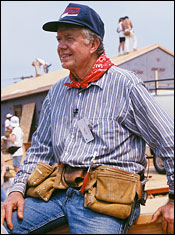 --This guy.
Or
---- This guy.The correct answer is both of these dudes. Because they both support worthy causes.
However, while Jimmy Carter's outfit is typically more homogeneous, Make it Right has the advantage of celebrity and with that in mind arranged for some of the best architects in the world to design their homes. (Click on the names to see what they are most famous for).
Shigeru Ban

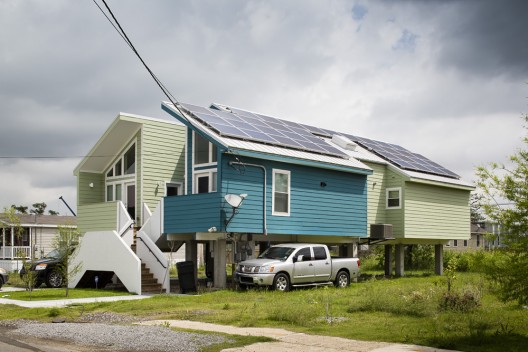
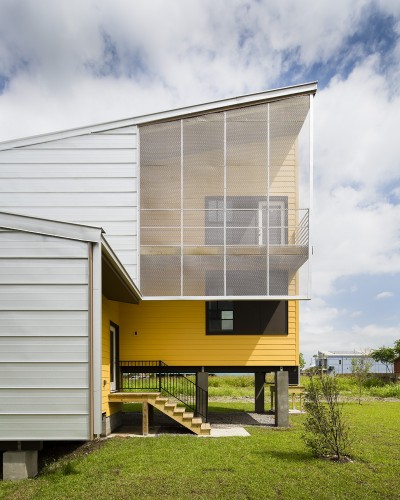

Yes, each one is a fascinating take on what a shotgun house lot can allow for. Clearly crafted by masters of the trade, creole influences, contemporary technology, functionality and just the right amount of ego. I am excited to see how they age as well.
When we first got to New Orleans I was especially interested in seeing the Make it Right houses as I had read so much about them. However, I was lost as to how to find them, as no addresses were listed on any website. This reminded me of the paradox of architectural interest, especially when it comes to residential works: on one side, you are curious about the object as an aesthetic piece, on the other, these are people's homes and you should respect their privacy. There in lies the darker side of celebrity endorsement, people are interested in helping, but they also want to see the result and take their share of pride.
While I did find the streets that the Make it Right houses were located on, I will not post it here. The important thing is that, should you want to see them, you should drive the whole area to see the place and also probably donate to the cause of rebuilding it.

The other interesting side of this development is the aging that has taken place thus far. On one end of the spectrum are the Make it Right houses that embrace nature, on the other, is the consuming methods of Nature itself. With the sharp decrease in population (about 1/2 from 2000 to 2010 according to the census) many places have been abandoned, leading them to be reclaimed by selfish nature of plants and man. For more information on this phenomenon, see point and counterpoint.
Conclusion:
New Orleans, city of music, dark sides, light sides and everything in between. She is a romantic survivor, she is Carmen, you will love her, she will leave you broken hearted but you can never blame her for it. She is not to be trusted and always to be adored.
Wednesday, June 27, 2012
Tuesday, June 26, 2012
New Orleans Trip Part II. The French Quarter: Like a rubber stamp that says " I just need one more chance"
Ahh the French Quarter, the backdrop of a hundred thousand mistakes
and regrets. Stories of love, passion, revenge, salvation, murder, God,
magic, monsters and everything in between, they all seem to play out so
well on this unique background. It's no wonder that this particular
section of New Orleans is a fountain of inspiration for artists of all
sorts, but especially writers. The two best examples of the gold the
French Quarter can produce are probably Tennessee Williams' ' A
Streetcar Named Desire' and John Kennedy Toole's 'A Confederacy of
Dunces' (we should note that a lot of the second book takes place on
Canal St., which is technically not the French Quarter but.... meh.).
I don't want to spoil either book, but 'Dunces' can be summed up as:
'Oh
Fortuna! Why hast thou spun me downward. My Boss hath told to stay out
of trouble...so a RIOT I shall start.Oohhh...nevermind there are
strippers..and birds..RIGHT HERE. This is awesome.'
While 'Desire' can be summed up thusly-
Also..you know..young Marlon Brando. You can watch him do anything. Eat a sandwich, channel surf, blink, whatever.
Anyway ARCHITECTURE.
So how does one house this passion? The best answer is uniquely.
The French quarter has it's own architectural standards that have persevered through flood, fire, famine and riot. There are a few kinds we want to touch on briefly. The first is the 'Shotgun House'. A Shotgun is thus named because, hypothetically, you can shoot a from the backdoor and the bullet should come out the front.


While extremely simple, the shotgun house ingeniously mixes function and economy. The straight row of doors allow for a quick cross ventilation of the house and is a natural fit for the linear plots of land that the original plan of the French Quarter encouraged (see previous post). You also essentially have two porches, one for the front and one for the back. I like this as a poetic interpretation of what you show to the world and what you really are.
There are several versions of this style, double shotgun, semi-detached, etc. The nicer ones have a kind of Colonial/Victorian molding which make them look like sweetest old lady in the world lives there. How can she afford it? The cute brigade pays her to have pies cooled on windowsills year round.

The next we want to cover is the Creole Townhouse
Creole townhouses are interesting because they attempt to blend Spanish and French Styles. The walls are the stucco and brightly painted colors of the Caribbean Colonies while the structure is a French post-and-brick. This technique does not rely too heavily on one material or the other, as in this climate, both can be unreliable. (Brick can sink, wood can burn). You might also notice a large number of Mansard roofs on the Creole townhouses in addition to the traditional Spanish-slate hipped. Additionally, most have a wrought iron balcony (or two depending on the exterior) that has come to be associated with much more lewd behavior than I think the original intent implies, especially on Bourbon St.


The interesting thing to note is how rarely the staircase is put out front and center. This is because only the closest guests are allowed upstairs. Along with the shotgun houses, we begin to see a pattern. The architecture implies a group of people who are easy to approach, but hard to know. Friendly and charming but also guarded and suspicious.

This changes when we are introduced to the "American Townhouses".
When the exotic northerners started congregating in New Orleans, they brought their northern ideas of townhomes with them. One idea was the somewhat strange notion (to them) that you would want main staircase to be a strong presence in your home. In colder climates this makes sense, as you are looking to condense space and expand fireplaces to retain heat. In a place like New Orleans, when it's so hot you feel like you are literally a walking ball of sweating lard, this makes less sense. However, fashion is as fashion does and the idea became popular.
Please note that the exterior of the houses stayed similar.
According to NOLA.gov, The Anglo-American Townhome can be also summed up thusly:
 "These townhouses were organized around the side hall which served as the
main entry to the house, as well as the chief means of internal
circulation. On the ground floor, the hall was flanked by the formal
rooms, the parlors and dining room, although in some cases the dining
room was placed at the end of the hall in the rear wing of the house.
Ascending the staircase to the second floor, one would find an
abbreviated hall that led to the bedrooms. The rear wing of the house
contained the kitchen and service rooms on the first floor and small
bedrooms on the second. It is generally significantly narrower than the
main house and contains no internal hallways."
"These townhouses were organized around the side hall which served as the
main entry to the house, as well as the chief means of internal
circulation. On the ground floor, the hall was flanked by the formal
rooms, the parlors and dining room, although in some cases the dining
room was placed at the end of the hall in the rear wing of the house.
Ascending the staircase to the second floor, one would find an
abbreviated hall that led to the bedrooms. The rear wing of the house
contained the kitchen and service rooms on the first floor and small
bedrooms on the second. It is generally significantly narrower than the
main house and contains no internal hallways."A good example of the French Quarter Townhomes is Latrobe's on Royal, designed by my one true love, Benjamin Henry Latrobe (Be still my heart).
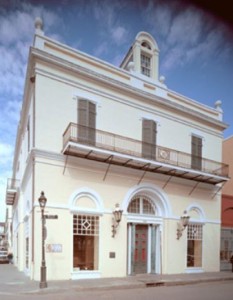


LaTrobe is bringing the idea of 'Classical' proportions while maintaining the accessible nature of the area via the 'Carriage door'. The ceilings are high and vast, but the upstairs is removed and private.
Next there is the jewel of the Crescent City, St. Louis Cathedral on Jackson Square.

Frequenters of this blog will know that I give tours at "America's First Cathedral: The Baltimore Basilica." However, technically it's not true. St. Louis' was built in 1721 and while not initially distinguished as a 'Cathedral' it was a serious landmark for the citizens. The original design burned down in the fire of 1788 and a new church was built in 1789. It was afterwards designated as a Cathedral (1795). The Baltimore Basilica was not started until 1806, however, a technicality in timing allows Baltimore to slide in for the win, but just barely.
Original Design

The interior has all the working organs of any other Cathedral, apse, nave, transept, etc., What makes it interesting are the balconies. Unlike the Gothic churches on which this design is based, the second floor has deep porches that allow for less light, but more seating/standing space. This will make the stained glass much less impressive, but in a place with massive heat gain, it makes sense to have a little less light and much more in terms of wall decoration.

The higher windows also allow for better ventilation.
Finally, because it is one of the coolest spots in the city, there is the above ground cemetaries. Some would say that the graves are not architecture as much as they are an interpretation or mimicry of architecture. To that I say:
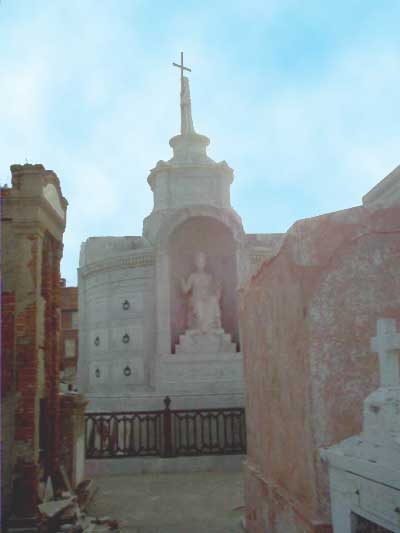
Booyah.
Cemetary #1 was started in 1789 after the aforementioned fire of 1788 ripped through the city. The idea of the above ground cemetary was adopted by the Spanish and made sense for two grisly reasons.
#1: The soil is basically playdough, so eventually the graves may come up, embarrasing the dead and freaking out the living, it's best to just avoid the whole thing.
#2: The mosoluems get so hot that people can litterally fry up in there, which basically creamates the bodies. Allowing for more people to be buried in the same plot. Convienient without being disrespectful.
The layout of the cemetaries (especially #1) is meandering and a little confusing, but also strangely organized, a messy desk, but you know where you put that thing. The whole place is peaceful, poetic and inherently creepy, but in a charming way.
Like this lady right here.
There are many interesting people who came to rest in this cemetary. Including, sadly,
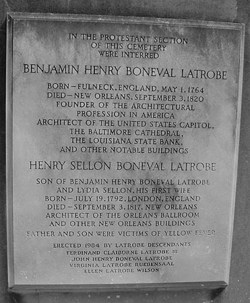
Also, this guy, Barthelemy Lafon, who I think deserves another Love Letter...and soon.
So we've got the basics, but what is the Quarter really like? Like it's history, it's a lot of things to a lot of different people. Touristy? Sure. Charming? Yes, that's why there are so many tourists. Gross, dirty and wrong? Only if you want it to be. The French Quarter knows who she is. You can love her or leave her, but you never forget her.
Plus, everywhere you go has amazing music.
The only criticism I have of the French Quarter is that it is almost too perfect. Most of the homes are monitored closely to ensure their historic significance is preserved, so much so that it kills all chance of it evolving further. These places have survived in the truest sense of the word but will now be in a state of arrested development, creating a paradox of a place that is both experienced and untouched by time. Then again, maybe we overrate the new, after all, as Ignatius once said:
"Possession of anything new or expensive only reflected a person's lack of theology and geometry; it could even cast doubts upon one's soul"
NEXT TIME ON NEW ORLEANS: Plantations, Piazzas, Public Buildings and other things that go "bump" in the night.
NEXT TIME ON NEW ORLEANS: Plantations, Piazzas, Public Buildings and other things that go "bump" in the night.
Subscribe to:
Posts (Atom)