Showing posts with label periodicals. Show all posts

Thursday, November 28, 2013

Academics Y'all

So sometimes I write academic stuff. So sometimes I edit journals. Here are some examples here:
I promise I will be less boring in my next post.

MA Thesis
In this thesis, the concepts of administration and bureaucracy are argued to be far more important on a personal level than any sort of material possession. By studying the aspects of administration and its subtle, mundane yet somehow bizarre logic, "Please Complete The Form" weaves together a story of laws, lies, perceptions, aspirations and an early morning wrecking ball which sought to destroy a legacy.
"The moment a name is written on a form, administrative space has been entered. Within this paper space, a person is only what they have self-identified, common symbols arranged in such a manner to indicate existence. The form is a dividing line between the personal and the individual within a strict machine: the individual being the physical embodiment of statistical data, the personal serving as something more mystical, more human. Though being human seems to be the lesser concern, as forms, and indeed the spaces which hold and process them, have a different understanding of the living and the dead. By simply miswriting information, one could technically live forever, or never exist, or be in two places at once, which results in a strange kind of immortality, particularly when it has to come to a lawsuit."
(For the full thesis, see below)

The Accidental Iconoclasts
“Art cannot be criticized because every mistake is a new creation”: this is the poster-dogma of self named street artist “Mr. Brainwash” for his first UK show, a reinvention of his premier show in L.A., Life is Beautiful (Old Sorting Office, New Oxford Street, Bloomsbury, London). Initially the spray painted image invokes an avant garde battle cry, however this call to arms may actually be an act self-defence, given the artist’s backstory. Mr. Brainwash came into the public eye via the documentary Exit Through the Gift Shop (2010) . Mixing the mythologies of Emperor Claudius and Darth Vader, an odd but otherwise harmless shop-owner becomes seduced by hype, media, and the benefits of being a dangerous Street Artist via his cousin, the artist Space Invader. To mark the metamorphosis, Thierry Guetta changes his name to “Mr. Brainwash” and via a large public show, betrays the Street Art community by stealing their ideas to gain notoriety. At the end of the film the viewer, like the other artists, is meant to mix revulsion and indignation at the commercial success of Mr. Brainwash. He is portrayed as someone who never truly suffered for his art or developed a style, a fraud. We’re meant to be mad not because he made money, but because he cheated.
(For the full article, see below)

Diamond Rock Stars and The People Who Watch Them
The Shard as we know it now, indivisible from the Southwark skyline, is a both a sign of the times and very much not. The most telling aspect of the building may not be the construction or layout, but in how it simultaneously orients and divides the profession of architecture. From conception to critique, it is both a fore-runner of possible trends and the beginning of the end for a particular kind of architectural persona. The building makes a defining statement about what it means to be "corporate" in a media-savvy and somewhat tech-oppressive environment. Indeed more than any other of Renzo Piano’s work or even Irvine Sellar’s (the man behind Sellar Property Group) investments, the Shard requires something more to be successful: the Shard needs love or better yet, envy. In its raw ambition, the Shard wants to be as photo-friendly as any other tourist spot in London, however there are elements that are preventing the architecture achieving this, elements that boil down to how the Shard is viewed by "us" and "them" .
(For the full article, see below)

A Perfectly Imagined Ruin
“I knew that good like bad, becomes a routine, that the temporary tends to endure, that what is external permeates to the inside, and that the mask, given time, comes to be the face itself.”
When Marguerite Yourcenar wrote the above in 1951 she was referencing the personal struggle of a man who eventually becomes the tyrant he was only pretending to be. Though specific in its imagining, this quote recalls another from Fredrich Nietzsche “Talking much about oneself can also be a means to conceal oneself.” Between these two reflections we can begin to identify a theme: the modern dilemma of labeling. As technology becomes faster, better, more malleable, as influence becomes vast, exotic, tenuous, it seems that to make a mark, to be remembered, requires a fantastic amount of self-assurance. Doubt is for dreams, regret is for memoirs and in the introduction at least, there can be no room for confusion: this is me. That self-assertion is as much about defining what you are as much as what you are not, often resulting in a simplistic ego that may not fit the intent. To become an icon, the modern author must assume whatever they pretend to be and Architects, as part of the authorial community, are not excused. Within the twentieth century in particular, the labeling of architects became the most vastly altered element of the field. Though one site in particular seems to be as philosophically challenging to labels as its designer (the subject of Yourcenar’s novel) was: The Villa Adriana.
(For the full article, see below)


Errrhhhhmmaaahhgerd Peeerrrblishing

Hey guys! Not to be too self-promoting, which is the most obnoxious thing for a blog to be, but I actually got PAID to WRITE something that I'm passionate about. For this I am extremely excited.

After I got the check I was so blown away I called the cockney-accented man whom I absolutely adore and told him:

"Get your coat baby I'm taking you out - anywhere you want."
"Anywhere?"
"Yes."
"Nando's. I want to go to Nando's."
"...really?"
"I'm a simple man. I love chicken and chips."

And while the looming dread of unemployment is the dark cloud hovering over an otherwise cheerful woman. I think maybe it's time to decide that a career isn't necessarily what other people tell you should want. What can I say, almost 10 years after I started studying architecture I'm still a Venturist.

There's a scene in "Room with a View" where a dreamy blonde turns over all the pictures in a room and writes a question mark on the back. If I was going to do that, it would now be an ampersand. But then again, the image would probably be enough for that. Or at least it would be for now.

See the article here.
http://www.saturatedspace.org/

I gotta go - chicken and chips is calling.

Wednesday, July 18, 2012

Tiptoe through the Tulips with Mies

So currently my house is somewhere between the minimalist De Stijl designs (empty and full of bright colors) and, how can I accurately put this, a garbage can (all my junk is piled into a corner). It has been said that if you want peace, you must prepare for war. Similarly, if I want to move out of this house, I must prepare to spend the rest of my life as a hoarder. 3. 3 copies of Zoolander. Who needs that many? No one, That's who.

But I digress.

In the process of boxing up the books, I was reminded of the good reads that have taken place during the 3 years I've lived here. So here - because you didn't ask for it - are my top ten favorite design books (today. right now.)

In the hope of not being too anecdotal I'm just going to put gifs down to sum up how I felt when I first read each of these books.

Why? Because it's the Internet.


#10) Phenomenology of Perception - Maurice Merleau-Ponty


#9) A Good Chair is A Good Chair - Donald Judd


#8) The Ice Palace that Melted Away - Bill Stumpf


#7) Architecture: Form, Space, Order - Francis D.K. Ching

  
#6) S,M,L,XL - Rem Koolhaas


#5) The Architecture of Happiness - Alain De Botton


#4) Philip Johnson: Life and Work - Franz Schulze


#3) History of the Future - Donna Goodman


#2) Complexity and Contradiction in Architecture - Robert Venturi


#1) 101 things you learn in Architecture School - Matthew Fredrick


Honorable Mention: Theorizing a New Agenda for Architecture: An Anthology of Architectural Theory 1965-1995 - Kate Nesbitt (technically a 'Best Of')

How about you guys? What were are your favorite design books?

Thanks to Whatshouldwecallme for the gifs.  


Thursday, September 16, 2010

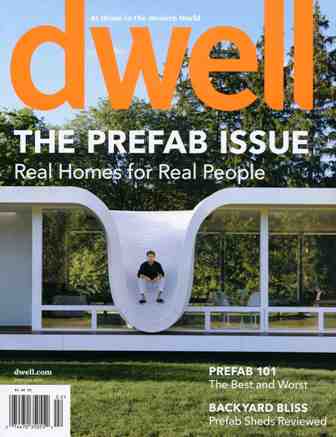
Happy 10th Birthday Dwell Magazine


This may be shameless plugging - but I like Dwell.


Architectural writing is often difficult to read, as most architects are under the absurd delusion that they are great writers. This theory has been proven false countless times.**


By my count, there have only ever been two great architects who also wrote well. I'll let you guess which ones. (Hint: John Ruskin is not one of them, I'm sorry he's just not.)


With Dwell, you get the most bang for your buck

-The writing style is accessible to both the architectural professional and the layman. Also, unlike other architectural magazines, it doesn't take itself too seriously.


The only real criticism I can give Dwell is that is does have a clear sense of self-satisfaction in the crispy cadence of its articles. Dwell is designed for a very specific clientele: someone who is interested in the appearance of looking like they know good, modern design. Dwell could also be called IkeaFancier.


That being said, if you're looking for a solid architecture periodical without too many made up or obscure words - go with Dwell

For an example, see this article regarding licensing:


http://www.dwell.com/articles/to-be-or-not-to-be-licensed.html


** Architects also think they are good at the following:

- Music
- Sports
- Film
- Drama
- Fashion
- Politics
- Economics
- Business
- Romance
- Everything

Tuesday, August 17, 2010

No Method to Our Madness, Just Manner in our Manors

In this month’s issue of Vanity Fair, there was a quite seductive reason for me to lay down the $5.99 (plus tax) to get the goods. It wasn’t Angelina Jolie doing her best Sophia Loren or the bright pink 72 point helvetica saying “SEX”, no, it was the article title of “50 TOP ARCHITECTS pick THE GREATEST BUILDINGS of the Last 30 YEARS”

(though I’m not going to lie, the “SEX” did initiate the interest, turns out it was about Maureen Dowd vacationing in Saudi Arabia, I keep forgetting that Vanity Fair is not Cosmopolitan and vice versa).

I was really interested to see what the crème de la crème picked as the best examples of their generation. This top ten is as follows:

#10
Architect: Sir Norman Foster Structure: Millau Viaduct, France Year Completed: 2004 Number of Votes: 4

#9
Architect: Maya Lin Structure: Vietnam Veterans Memorial, Washington, D.C. Year Completed: 1982 Number of Votes: 5


#8
Architect: Tadao Ando Structure: Church of the Light, Osaka, Japan Year Completed: 1989 Number of Votes: 6

#7
Architect: Sir James Stirling Structure: Neue Staatsgalerie, Stuttgart, Germany Year Completed: 1984 Number of Votes: 6

#6
Architect: Toyo Ito Structure: Mediatheque building, Sendai, Japan Year Completed: 2001 Number of Votes: 6

#5
Architect: Rem Koolhaas (Office for Metropolitan Architecture) Structure: Seattle Central Library Year Completed: 2004 Number of Votes: 6

#4
Architect: Sir Norman Foster Structure: HSBC Building, Hong Kong Year Completed: 1985 Number of Votes: 7

#3
Architect: Peter Zumthor Structure: Thermal Baths, Vals, Switzerland Year Completed: 1996 Number of Votes: 9

#2

Architect: Renzo Piano Structure: Menil Collection, Houston Year Completed: 1987 Number of Votes: 10

#1
Architect: Frank Gehry Structure: Guggenheim Museum, Bilbao, Spain Year Completed: 1997 Number of Votes: 28

I looked through the article and it was actually pretty even handed. Acknowledging that we are in the age of STARCHITECTURE but not criticizing it too harshly, that is except for Peter Eisenman who wrote to as his top five:

#1: Firminy, Le Corbusier
#2: Nothing else, All PM junk

Eisenman always gets to me, one the one hand, I hate that he only likes dead people, but at the same time he includes himself amongst the wretched living. Intellectuals man, go fig.

Though, I think Bilbao did deserve to win.

Frank Ghery often gets criticized for his buildings being “fluff” or “dumb” and that if you are looking for more serious architecture, you should opt for the more conservative and far more cerebral, Renzo Piano. However, as Piano quotes himself “ People say “ok. Renzo Piano is the opposite of Frank Ghery” … I think all this is just silly.”

This article was certainly interesting as a window into contemporary architecture. It reminds us that in the post-postmodern, Robert Venturi's mantra found in Complexity and Contradiction has become the unspoken (and certainly never-admitted to) law.

Vanity Fair stated that we are living in the "Age of Ghery", I have to disagree - We are not in the age of Ghery as much as we are in the age of "inclusive architecture" over "exclsive architecture."

This makes the whole business tougher because the core concepts of freedom and self-expression require ingenuity rather than the perfection of a tried and true method.

Not only do you have to re-invent the wheel, you have to explain that it rolls, like, all the time.

Keeping that in mind, it’s easy to blame your Daniel Burnhams or Bernard Maybeks for keeping the “revolutionary architects” back, but part of "inclusive architecture" means we have to admire their work just as much as a Koolhaas or a Foster . It may be apples and oranges, but in the end they're both fruit. I’m glad that as a field we have come to accept that.

Long story short: not a lot of surprises, except for two

Firstly, Le Corbusier made the top 30 even though he hasn’t been practicing for 45 years (being dead has its disadvantages). A church , Firminy, as previously mentioned, was built in 2006 based off of one of his later designs - there is just no escaping the raven-like one or this mystique that the architectural elite seem to have of fearing a god long since dead.

Secondly, I noticed there wasn’t ONE residential listing in the top 20 (with the possible exception of the Peter Zumthor entry). Maybe there was a misunderstanding on my part, as this compedium consists of “buildings” and not “houses” but let’s call a spade a spade, shall we?

It seems the humble architecture of the home isn’t very popular right now. If you did the same article in 1970, it would be nothing BUT houses. Not to wax nostalgic, but in that era, people could afford a Khan or a Wright and the larger scale projects were typically the punched-hole big-box variety. That seems to have all changed with Bilbao, suddenly the perfect house is'nt as appealing as public glory.

I guess the rich are different from you and me, they rent.

Overall, Starchitecture does a few funny things. This kind of architecture (and yes, for this article they are all being lumped together) is simultaneously extremely public and snobbishly exclusive. Massive structures that seem indifferent as to whether or not the are human-scale or even percieved as beautiful for that matter. The references and concepts behind the building may be "inclusive", that is drawings from many different styles to form their own, but the dependence on wide-spread public admiration is shattered.

Sure - Anyone can go, but not everyone can get it.

For the slide-show see link --> http://www.vanityfair.com/culture/features/2010/08/architecture-survey-list-201008