Showing posts with label writing. Show all posts

Thursday, May 29, 2014

A Cosmic Dance of Bursting Decadence and Withheld Permissions - The Dennis Severs House

So if you're following the blog, it's no secret that East London is probably my favorite place in the world. When I moved here it kind of felt like one of those coming-of-age movies from the 90s about 'the summer that changed everything' but with way more hard liquor and a better soundtrack. And indeed, in certain parts of Shoreditch, the obnoxiousness of never-ending adolescence is still strong in the streets. Regardless - East London is where I became the person I always wanted to be: it's where I fell in love, it's where I started dying my hair and wearing clothes that fit, and against the best backdrop in the world I was finally happy: hundreds of years of history and an ever-changing landscape. This is not to say I'm immune to its flaws. If I have to walk into one more hipster bar and pay 9$ for a beer while some dingus wearing Google Glass explains why I should be doing their design work for free, I'm going to yak.

Though I'm not the only American to fall prey to the charms of Spitalfields, there have been many before me but who exceeded all collective eccentricities and definitely had more money. Was the king of the desperate romantics: Dennis Severs.

Dennis Severs had been brought up in post-war California, and while the likes of Reyner Banham were dreaming of the place-less reinvention that the West provides, Severs longed to be part of something older. After years of costume dramas on TV, Severs arrived in London in the 1970s, but found something not at all to his tastes. It was a rapidly industrializing place and the city workers were getting more encompassing by the day. Instead of accepting his disappointment and adjusting, he simply ignored the development around him and decided to live in the past. Sort of like the Amish or Japan's rejection of firearms for 300 years.


The past became Severs medium: he began by buying an authentic handsome cab and giving rides. But after his stable was demolished by developers, he needed to find another outlet. So he bought a ramshackle house at 18 Folgate Street and started to work.

He decided that he was going to invent a family of Huguenots silk merchants, their beginnings as hard working protestants to grasping decadence and further to their inevitable decline. Each room in the house was going to be a total experience, sights, smells, sounds. All in perfect silence while Severs described this fantastical history. Here's a quick recap starting from the bottom-up:

Basement Cellar - The remnants of the leper burial plot from St. Mary's Spital (hence the name: Spitalfields)

Basement Kitchen - The beginning of sensory development, in an almost Frank Lloyd Wright philosophy, he reminds the viewer that the Latin word for hearth is focus. So the fire is the axis on which the rest of the home moves (editorial note: I've always disagreed with this statement, though maybe because I've always had central heat)


First Floor Dining Room - The "Jarvis Family" (again, a complete invention by Severs) move in and are the kind of hard-working patriarchs one might expect. Food half eaten, a clean, functional, warm space filled with orders and announcements.


Second Floor Parlor - It seems a generation later, their protestant beginnings have started to give way to the Enlightenment principles of Kantian aesthetics: not a single thing should be added or removed, the room is complete.
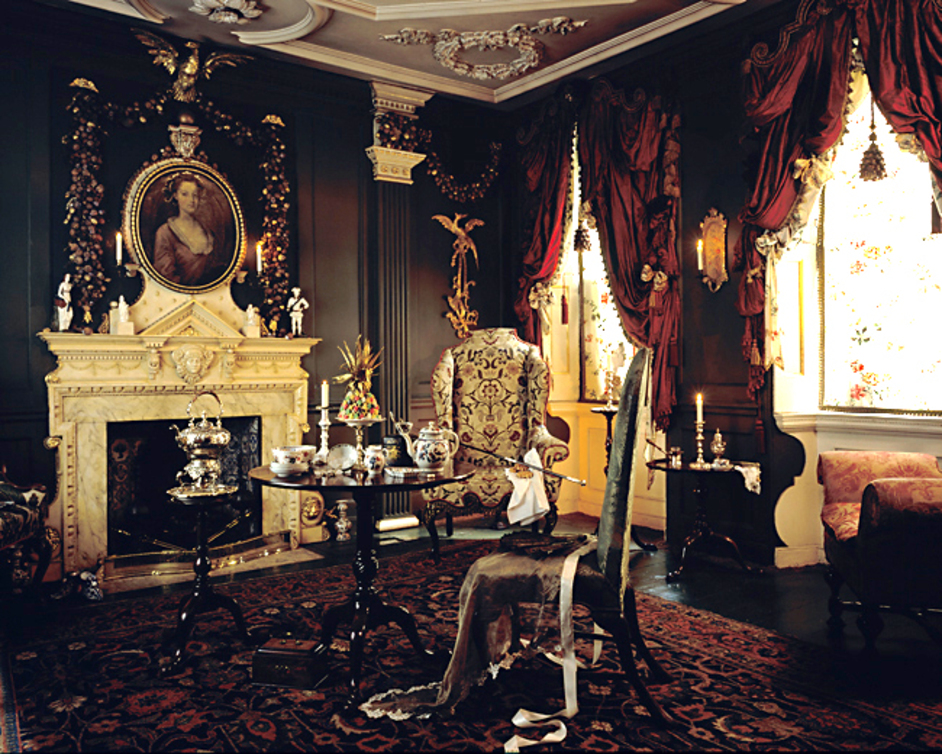
Second Floor Smoking Room - Though all is not well with the Jarvis Family, the heir is a lout and a drunkard, a spoiled rich-kid who daddy never paid attention to. The thing that is to be noted in this room is the vast number of blood-letting bowls, a common treatment for people suffering from Gout. Turned over chairs and the pungent smell of tobacco pervades. According to the myth, the young heir eventually hung himself in the attic, something that is noted in a portrait in the upstairs room - speaking of which.
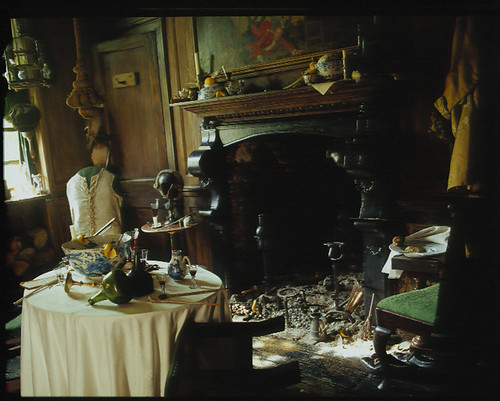


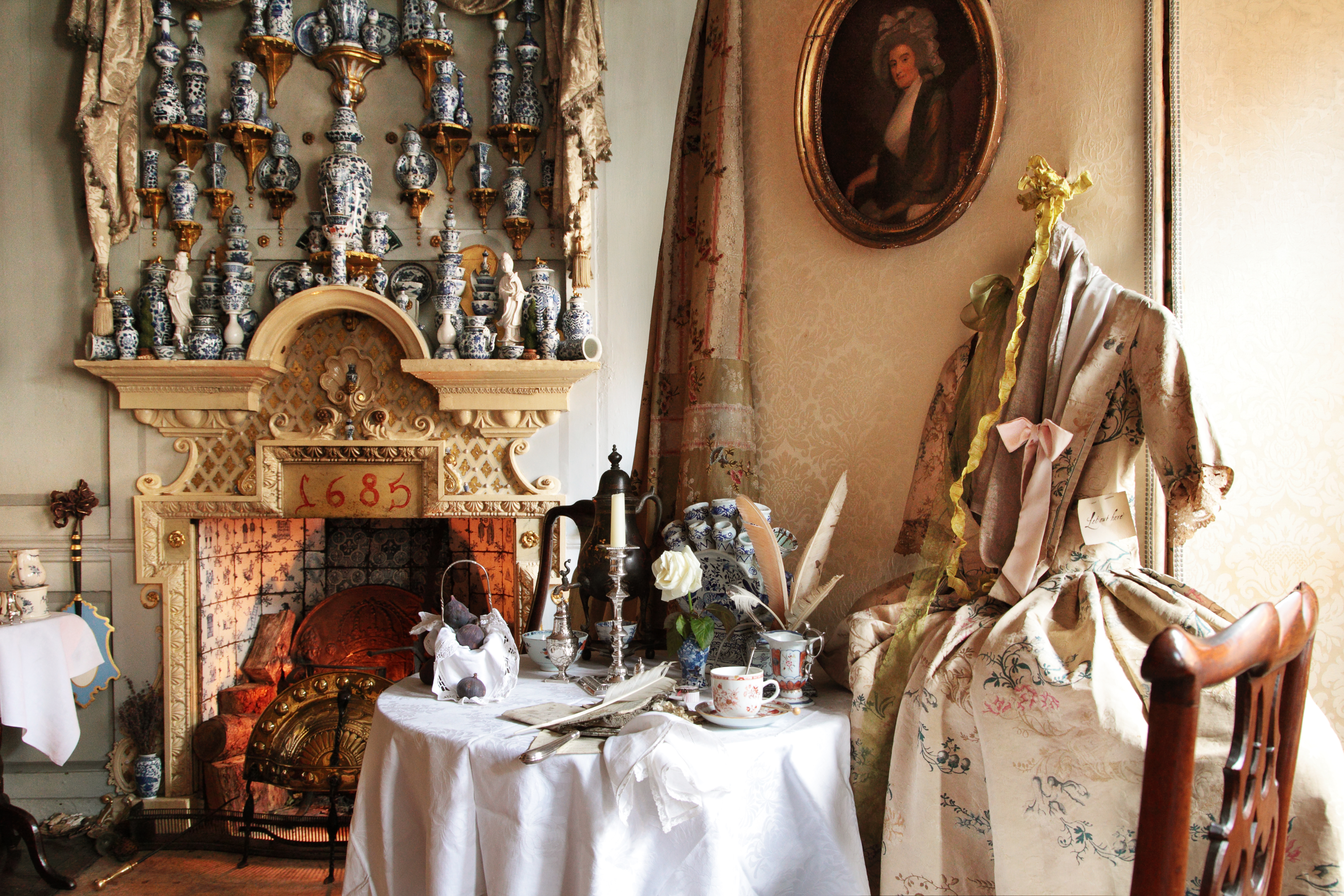
Third Floor Bedrooms - A young girls room is immediately on the left as you come up the stairs is covered with subtle notes of a broken heart. A portrait of a young man with a black ribbon tied around it, dozens of pictures of happy couples, this girl wants to be loved. Bad. The other bedroom is presumably of her mother, an eccentric who would have been a hoarder if taste had allowed. This place is lousy with blue and white china.


The Lodgers Rooms - But it's here where the story gets dark, fast. In an almost Dickensian turn of events, the Jarvis silk business is waning now that the industrial revolution has taken hold and they are taking in poor lodgers. Notes from "Scrooge and Marley, Esq." are posted all around, presumably these are bills for unpaid rent. This setting also makes sense as Victorian Spitalfields was the haunt of Jack the Ripper and various unsavory folks.


First Floor Parlor - Though it seems the Jervis' survive long enough to make it to the late Victorian period. The last room you enter is at the bottom of the stairs, just before you exit. Here the cult of personality that surrounds Victoria and Albert is in full swing, with over-decoration and stuffed chairs to match.


As you exit the house, you're leaving on the eve of 1912, as a subtle newspaper cutting on the wall describes. World War is upon you, and as you exit onto modernity, you know the world of the Jarvis' is over.

I liked it, though it is slightly disturbing. Though by far my favorite part was the hallway decorations. On the first floor, a magnificent candied fruit display sits delicately on a wooden table. Anyone who has been in enough museums would recognize it immediately as an objet d'art. One that, should it be on display in any other forum, would be a nice piece of pottery and nothing else. Here it is being used for its intention, and is all the more beautiful for it.

The main gist of this whole house is either you get it or you don't. A viewer will either see an intense Gesamtkunstwerk of a still lives and people just outside of sight or a total weirdo whose obsession with the past is just an uncomfortable side effect of mental illness. It's kind of up to you.

I think I get it because I understand Severs longing desire for a world not his own. More than once people have asked me why I don't want to live in the place I grew up. At the end of the day, it's because the person I was when I lived there wasn't a person I liked being: insecure and jealous, awkward and lonely. It was the liberation of all that middle-class, white bread, meet a nice boy and settle-down expectation that made me happy for the first time in years. And that liberation came in the form of constraint. Constraint by history.

History has the ability to make you feel connected to a longer tradition, even if it's one you invent, like Severs did.

Though at the end of the day, the obsession eventually consumed Severs and in the last years of his life, he sought to escape the world he created, realizing that there was no way to continue this obsession. Maybe that's the trap of reinvention, if its tied too closely to a place, then its never really yours.


Tuesday, April 8, 2014

The Wonderful World of Architectural Writing

So I've been kind of lax in posting my other writings on the blog here.

I assure you it is not from lack of work but neither am I going to complain with my least favorite excuse: "I'm so busy". The answer is that I now share a wall with my infant niece and the lack of sleep that produces has made me all kinds of scatter-brained. But nevermind that, without further ado -


Madness and Method at St. Elizabeths
Washington D.C.’s next major addition is a department headquarters that challenges the city’s views on temporality, functionality and even irony. The site is a place of madness, method and the schemes in between; one the government both embraces and fears.
Published by 'Failed Architecture' April 2014 See the full article HERE


Next Time, Send Flowers
In this short essay, misappropriated art theory and fame are discussed in the scope of a recent tabloid obsession. A Hollywood superstar's plagerism, some bizarre skywriting and a gallery show are all clues, but who is the culprit in this crime of art theft?
Published by 'Resonance' the Architectural Association History and Critical Thinking Research Platform, March 2014 See Full Article HERE


Changing Times, Changing Designs: Council Offices Then and Now
What does the design of local government say about surrender, duty and the perceptions of power? Camden’s replacement of their Brutalist Council Office Building with a new one, gives a clue.
Published by 'Failed Architecture' January 2014 See the full article HERE


The Nothing That Consumes: How Battleship Grey Changed Design
In 1909 the Royal Navy began painting everything within grasp a vague, nothing kind of colour, one that was intended to be useful, not beautiful. Yet over 100 years later “Battleship Gray” has become the inescapable basis of almost all design and subsequently, most of the physical world. More than a post-war standard-issue metaphor for bureaucratic oppression, or a dogmatic footnote in architectural academia, it is the colour of purgatory and boredom, the promise of a future while the soul is mortgaged: doing far more for and to design that it has ever been credited for. Further, the only way to break the bonds of its oppression is to acknowledge it as fact.
Published by 'Saturated Space' Nov 2013 Read the full article HERE

There is also talk of my work being published in a book. I won't say anything more about it than I am excited and dubious.

Now if I could only devise a way to get babies to sleep through the night. 

Thursday, November 28, 2013

Academics Y'all

So sometimes I write academic stuff. So sometimes I edit journals. Here are some examples here:
I promise I will be less boring in my next post.

MA Thesis
In this thesis, the concepts of administration and bureaucracy are argued to be far more important on a personal level than any sort of material possession. By studying the aspects of administration and its subtle, mundane yet somehow bizarre logic, "Please Complete The Form" weaves together a story of laws, lies, perceptions, aspirations and an early morning wrecking ball which sought to destroy a legacy.
"The moment a name is written on a form, administrative space has been entered. Within this paper space, a person is only what they have self-identified, common symbols arranged in such a manner to indicate existence. The form is a dividing line between the personal and the individual within a strict machine: the individual being the physical embodiment of statistical data, the personal serving as something more mystical, more human. Though being human seems to be the lesser concern, as forms, and indeed the spaces which hold and process them, have a different understanding of the living and the dead. By simply miswriting information, one could technically live forever, or never exist, or be in two places at once, which results in a strange kind of immortality, particularly when it has to come to a lawsuit."
(For the full thesis, see below)

The Accidental Iconoclasts
“Art cannot be criticized because every mistake is a new creation”: this is the poster-dogma of self named street artist “Mr. Brainwash” for his first UK show, a reinvention of his premier show in L.A., Life is Beautiful (Old Sorting Office, New Oxford Street, Bloomsbury, London). Initially the spray painted image invokes an avant garde battle cry, however this call to arms may actually be an act self-defence, given the artist’s backstory. Mr. Brainwash came into the public eye via the documentary Exit Through the Gift Shop (2010) . Mixing the mythologies of Emperor Claudius and Darth Vader, an odd but otherwise harmless shop-owner becomes seduced by hype, media, and the benefits of being a dangerous Street Artist via his cousin, the artist Space Invader. To mark the metamorphosis, Thierry Guetta changes his name to “Mr. Brainwash” and via a large public show, betrays the Street Art community by stealing their ideas to gain notoriety. At the end of the film the viewer, like the other artists, is meant to mix revulsion and indignation at the commercial success of Mr. Brainwash. He is portrayed as someone who never truly suffered for his art or developed a style, a fraud. We’re meant to be mad not because he made money, but because he cheated.
(For the full article, see below)

Diamond Rock Stars and The People Who Watch Them
The Shard as we know it now, indivisible from the Southwark skyline, is a both a sign of the times and very much not. The most telling aspect of the building may not be the construction or layout, but in how it simultaneously orients and divides the profession of architecture. From conception to critique, it is both a fore-runner of possible trends and the beginning of the end for a particular kind of architectural persona. The building makes a defining statement about what it means to be "corporate" in a media-savvy and somewhat tech-oppressive environment. Indeed more than any other of Renzo Piano’s work or even Irvine Sellar’s (the man behind Sellar Property Group) investments, the Shard requires something more to be successful: the Shard needs love or better yet, envy. In its raw ambition, the Shard wants to be as photo-friendly as any other tourist spot in London, however there are elements that are preventing the architecture achieving this, elements that boil down to how the Shard is viewed by "us" and "them" .
(For the full article, see below)

A Perfectly Imagined Ruin
“I knew that good like bad, becomes a routine, that the temporary tends to endure, that what is external permeates to the inside, and that the mask, given time, comes to be the face itself.”
When Marguerite Yourcenar wrote the above in 1951 she was referencing the personal struggle of a man who eventually becomes the tyrant he was only pretending to be. Though specific in its imagining, this quote recalls another from Fredrich Nietzsche “Talking much about oneself can also be a means to conceal oneself.” Between these two reflections we can begin to identify a theme: the modern dilemma of labeling. As technology becomes faster, better, more malleable, as influence becomes vast, exotic, tenuous, it seems that to make a mark, to be remembered, requires a fantastic amount of self-assurance. Doubt is for dreams, regret is for memoirs and in the introduction at least, there can be no room for confusion: this is me. That self-assertion is as much about defining what you are as much as what you are not, often resulting in a simplistic ego that may not fit the intent. To become an icon, the modern author must assume whatever they pretend to be and Architects, as part of the authorial community, are not excused. Within the twentieth century in particular, the labeling of architects became the most vastly altered element of the field. Though one site in particular seems to be as philosophically challenging to labels as its designer (the subject of Yourcenar’s novel) was: The Villa Adriana.
(For the full article, see below)

Errrhhhhmmaaahhgerd Peeerrrblishing

Hey guys! Not to be too self-promoting, which is the most obnoxious thing for a blog to be, but I actually got PAID to WRITE something that I'm passionate about. For this I am extremely excited.

After I got the check I was so blown away I called the cockney-accented man whom I absolutely adore and told him:

"Get your coat baby I'm taking you out - anywhere you want."
"Anywhere?"
"Yes."
"Nando's. I want to go to Nando's."
"...really?"
"I'm a simple man. I love chicken and chips."

And while the looming dread of unemployment is the dark cloud hovering over an otherwise cheerful woman. I think maybe it's time to decide that a career isn't necessarily what other people tell you should want. What can I say, almost 10 years after I started studying architecture I'm still a Venturist.

There's a scene in "Room with a View" where a dreamy blonde turns over all the pictures in a room and writes a question mark on the back. If I was going to do that, it would now be an ampersand. But then again, the image would probably be enough for that. Or at least it would be for now.

See the article here.
http://www.saturatedspace.org/

I gotta go - chicken and chips is calling.