
Saturday, November 30, 2013
AIA Membership Elevation
Hi there. I just wanted to share with you that once you become licensed you must complete a hardcopy application called the "Architect Membership Elevation Form" in order to achieve AIA status in the AIA. I thought that by inputting my license information into my profile on the AIA website that this would be the only step necessary. Only when I went to renew my dues did I realize they still had me as Associate AIA and that this was the only way to update your membership. Seems a little redundant, as I said I already submitted my license number, but they require a photocopy of your state license document. Guess I will take care of that on Monday!

Thursday, November 28, 2013
Academics Y'all
So sometimes I write academic stuff. So sometimes I edit journals. Here are some examples here:
I promise I will be less boring in my next post.
I promise I will be less boring in my next post.
MA Thesis
In this thesis, the concepts of administration and bureaucracy are argued to be far more important on a personal level than any sort of material possession. By studying the aspects of administration and its subtle, mundane yet somehow bizarre logic, "Please Complete The Form" weaves together a story of laws, lies, perceptions, aspirations and an early morning wrecking ball which sought to destroy a legacy.
"The moment a name is written on a form, administrative space has been entered. Within this paper space, a person is only what they have self-identified, common symbols arranged in such a manner to indicate existence. The form is a dividing line between the personal and the individual within a strict machine: the individual being the physical embodiment of statistical data, the personal serving as something more mystical, more human. Though being human seems to be the lesser concern, as forms, and indeed the spaces which hold and process them, have a different understanding of the living and the dead. By simply miswriting information, one could technically live forever, or never exist, or be in two places at once, which results in a strange kind of immortality, particularly when it has to come to a lawsuit."
(For the full thesis, see below)
The Accidental Iconoclasts
“Art cannot be criticized because every mistake is a new creation”: this is the poster-dogma of self named street artist “Mr. Brainwash” for his first UK show, a reinvention of his premier show in L.A., Life is Beautiful (Old Sorting Office, New Oxford Street, Bloomsbury, London). Initially the spray painted image invokes an avant garde battle cry, however this call to arms may actually be an act self-defence, given the artist’s backstory. Mr. Brainwash came into the public eye via the documentary Exit Through the Gift Shop (2010) . Mixing the mythologies of Emperor Claudius and Darth Vader, an odd but otherwise harmless shop-owner becomes seduced by hype, media, and the benefits of being a dangerous Street Artist via his cousin, the artist Space Invader. To mark the metamorphosis, Thierry Guetta changes his name to “Mr. Brainwash” and via a large public show, betrays the Street Art community by stealing their ideas to gain notoriety. At the end of the film the viewer, like the other artists, is meant to mix revulsion and indignation at the commercial success of Mr. Brainwash. He is portrayed as someone who never truly suffered for his art or developed a style, a fraud. We’re meant to be mad not because he made money, but because he cheated.
(For the full article, see below)
Diamond Rock Stars and The People Who Watch Them
The Shard as we know it now, indivisible from the Southwark skyline, is a both a sign of the times and very much not. The most telling aspect of the building may not be the construction or layout, but in how it simultaneously orients and divides the profession of architecture. From conception to critique, it is both a fore-runner of possible trends and the beginning of the end for a particular kind of architectural persona. The building makes a defining statement about what it means to be "corporate" in a media-savvy and somewhat tech-oppressive environment. Indeed more than any other of Renzo Piano’s work or even Irvine Sellar’s (the man behind Sellar Property Group) investments, the Shard requires something more to be successful: the Shard needs love or better yet, envy. In its raw ambition, the Shard wants to be as photo-friendly as any other tourist spot in London, however there are elements that are preventing the architecture achieving this, elements that boil down to how the Shard is viewed by "us" and "them" .
(For the full article, see below)
A Perfectly Imagined Ruin
“I knew that good like bad, becomes a routine, that the temporary tends to endure, that what is external permeates to the inside, and that the mask, given time, comes to be the face itself.”
When Marguerite Yourcenar wrote the above in 1951 she was referencing the personal struggle of a man who eventually becomes the tyrant he was only pretending to be. Though specific in its imagining, this quote recalls another from Fredrich Nietzsche “Talking much about oneself can also be a means to conceal oneself.” Between these two reflections we can begin to identify a theme: the modern dilemma of labeling. As technology becomes faster, better, more malleable, as influence becomes vast, exotic, tenuous, it seems that to make a mark, to be remembered, requires a fantastic amount of self-assurance. Doubt is for dreams, regret is for memoirs and in the introduction at least, there can be no room for confusion: this is me. That self-assertion is as much about defining what you are as much as what you are not, often resulting in a simplistic ego that may not fit the intent. To become an icon, the modern author must assume whatever they pretend to be and Architects, as part of the authorial community, are not excused. Within the twentieth century in particular, the labeling of architects became the most vastly altered element of the field. Though one site in particular seems to be as philosophically challenging to labels as its designer (the subject of Yourcenar’s novel) was: The Villa Adriana.
(For the full article, see below)
Errrhhhhmmaaahhgerd Peeerrrblishing
Hey guys! Not to be too self-promoting, which is the most obnoxious thing for a blog to be, but I actually got PAID to WRITE something that I'm passionate about. For this I am extremely excited.
After I got the check I was so blown away I called the cockney-accented man whom I absolutely adore and told him:
"Get your coat baby I'm taking you out - anywhere you want."
"Anywhere?"
"Yes."
"Nando's. I want to go to Nando's."
"...really?"
"I'm a simple man. I love chicken and chips."
And while the looming dread of unemployment is the dark cloud hovering over an otherwise cheerful woman. I think maybe it's time to decide that a career isn't necessarily what other people tell you should want. What can I say, almost 10 years after I started studying architecture I'm still a Venturist.
There's a scene in "Room with a View" where a dreamy blonde turns over all the pictures in a room and writes a question mark on the back. If I was going to do that, it would now be an ampersand. But then again, the image would probably be enough for that. Or at least it would be for now.
See the article here.
http://www.saturatedspace.org/
I gotta go - chicken and chips is calling.
After I got the check I was so blown away I called the cockney-accented man whom I absolutely adore and told him:
"Get your coat baby I'm taking you out - anywhere you want."
"Anywhere?"
"Yes."
"Nando's. I want to go to Nando's."
"...really?"
"I'm a simple man. I love chicken and chips."
And while the looming dread of unemployment is the dark cloud hovering over an otherwise cheerful woman. I think maybe it's time to decide that a career isn't necessarily what other people tell you should want. What can I say, almost 10 years after I started studying architecture I'm still a Venturist.
There's a scene in "Room with a View" where a dreamy blonde turns over all the pictures in a room and writes a question mark on the back. If I was going to do that, it would now be an ampersand. But then again, the image would probably be enough for that. Or at least it would be for now.
See the article here.
http://www.saturatedspace.org/
I gotta go - chicken and chips is calling.
Friday, November 1, 2013
Drafting Standards from NCS
When I first learned, years ago, that the AIA had come up with a system for Auto-CAD layers, I thought it was super nerdy of them. However, having bounced around to a few different firms, I subsequently find it incredibly helpful and logical. The AIA, or NCS, format is thorough but concise. In an effort to start establishing my own CAD standards, be they layers or titles blocks or symbols, etc., I am starting to look into this a bit more. So far, I have found a number of free PDF downloads that kind of give you a taste of this organizational nerdiness (you can find the PDF's at this NCS website). I think the comprehensive list of layers and such may be a part of the license package that costs upwards of $400. I think for my personal purposes, I can get away with creating the few layers and standards that I need by myself.
As a side note, I started looking into CAD standards because I'd like to start getting into projects on my own. I have some small projects that don't really require a lot of drafting, but I'd like to get more actual work, which of course involves drafting. Analyzing my options for CAD software, it would seem that my MacBook Pro is too old (in spite of its upgrades) to accept any current CAD or BIM software. And even if it could, that would cost somewhere around $2,000 - $4,000. But since I can't install the current software (they don't sell older software, they only let you buy the current stuff), I'd have to buy a new computer which would also probably cost $1,000 - $2,000. So to do some small drafting gig on the side, I would have an immediate initial bullet to bite of somewhere between $3,000 - $6,000. Um, for that pocket piece I could get new living room and dining room furniture!
However, I remembered that I still have AutoCAD 2006 from school on my old desktop computer, which I booted up today and am tickled to say that it runs swimmingly. I'm going to play around with it the next few weeks and see if it will suffice for my purposes.
As a side note, I started looking into CAD standards because I'd like to start getting into projects on my own. I have some small projects that don't really require a lot of drafting, but I'd like to get more actual work, which of course involves drafting. Analyzing my options for CAD software, it would seem that my MacBook Pro is too old (in spite of its upgrades) to accept any current CAD or BIM software. And even if it could, that would cost somewhere around $2,000 - $4,000. But since I can't install the current software (they don't sell older software, they only let you buy the current stuff), I'd have to buy a new computer which would also probably cost $1,000 - $2,000. So to do some small drafting gig on the side, I would have an immediate initial bullet to bite of somewhere between $3,000 - $6,000. Um, for that pocket piece I could get new living room and dining room furniture!
However, I remembered that I still have AutoCAD 2006 from school on my old desktop computer, which I booted up today and am tickled to say that it runs swimmingly. I'm going to play around with it the next few weeks and see if it will suffice for my purposes.
Sunday, October 20, 2013
HARB - Pros and Cons
What is your experience with, or thoughts regarding, Historic Architectural Review Boards? I have limited direct experience with them personally, but have heard and read and indirectly experienced several different perspectives.
Lately, my thoughts have been that they are a positive feature of a community, because in my own community there has been a lot of discussion about possibly forming an Historic District, which is exciting to me. In my mind, the HARB would consist of passionate and compassionate board members who have knowledge for and unbiased appreciation of the local historic architecture.
A recent discussion with a colleague who is very much anti-HARB made me realize that what I imagine and what actually comes to fruition with the boards are not one in the same.
Ideally, HARB would guide and educate property-owners in the maintenance and aesthetics of their properties. However, what more often seems to be the case is HARB becomes another money-grab hoop that designers, owners and builders have to jump through, and to perhaps an ineffectual end.
After listening to my colleague's argument and reflecting on the stories cataloged in my brain, I have to say that HARB is a great idea in theory, but it is poorly executed in practice.
What do you think about HARB? What are your pros and cons?
Pro
Lately, my thoughts have been that they are a positive feature of a community, because in my own community there has been a lot of discussion about possibly forming an Historic District, which is exciting to me. In my mind, the HARB would consist of passionate and compassionate board members who have knowledge for and unbiased appreciation of the local historic architecture.
A recent discussion with a colleague who is very much anti-HARB made me realize that what I imagine and what actually comes to fruition with the boards are not one in the same.
Ideally, HARB would guide and educate property-owners in the maintenance and aesthetics of their properties. However, what more often seems to be the case is HARB becomes another money-grab hoop that designers, owners and builders have to jump through, and to perhaps an ineffectual end.
After listening to my colleague's argument and reflecting on the stories cataloged in my brain, I have to say that HARB is a great idea in theory, but it is poorly executed in practice.
What do you think about HARB? What are your pros and cons?
Pro
- Maintenance of neighborhood character
- Guidance for property-owners on creating historically accurate improvements
Con
- Board members may or may not have the expertise to offer actual guidance
- Board members may have very finite or subjective grounds for approval
- The owner's added cost of preparing for HARB reviews and permitting
Thursday, October 3, 2013
Some last minute stops before we're lost at sea again.
So now that my grad school thesis is turned in I decided to reward myself in the dorkiest way possible: by going to visit museums. The cockney man I love was not able to come with me so it was kind of interesting getting involved in London's history spots without someone I can ask a bevy of questions to.
Questions like: "Is marmite an actual food or is used just for torture?" or "Do people in England really think that Ben Franklin was a serial killer?" But here we go:
Stop 1) The Handel Museum

Did you know that Jimmy Hendrix and Handel lived in the same row home in west London? Because I didn't. And honestly, that is kind of the only architectural interest of this house. Not to be dismissive to the museum, or it's staff, who were lovely. But unless you're super into Hanoverians, Harpsichords or dope-ass wigs. It's a row-home that has a very nice open spaces and a flat in the attic. I'd skip it. Though the restaurant in the little courtyard out back is nice.

Stop 2) The Dickens Museum
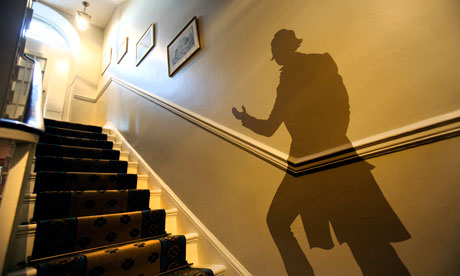
The Dickens Museum on the other hand is much more interesting and maybe because as a person, Dickens is just more interesting. Handel was incredibly private but Dickens may have been the human equivalent of a Chihuahua high on cocaine: the dude had some energy. The house itself is what a respectable Victorian home should be, and for that, it's interesting. It's lush, but compact, pretentious but not insincere. As someone who only recently started to get into cooking I can state that the kitchens were fascinating, particularly the sinks which seemed to have been a huge piece of stone carved into the shape of a utility sink.
Yet what I liked best about this museum was that it felt like the home that a writer would live in. It was comfortable but bright. Secluded but not isolated. It was the home of someone who works from home.
Off-topic: he was not cool to his wife. but then again she was loopy on drugs. also kind of dumb. Seriously look it up. Somebody hit a mid-life crisis wall hard.

SPEAKING OF WIVES!!!!
Stop 3) Hampton Court Palace

This was a place I had been dying to get to all year but like going the post-office, I hadn't found time. Well not anymore. Instead I took the noon train from Waterloo to Kingston-Upon-Thames. If one had been part of Henry VIII's court one would have taken a boat there (or back depending on if you were going to get your head cut off). But I'm rabble at best, so it's public transport for this kid.
The story of Hampton court is actually a tale of two buildings. The first one being the Renaissance Palace of a certain Cardinal Wolsey who had both sense and power, but not quiet enough as it would turn out. The other being Christopher Wren's palace for William and Mary on the other side. Both are really interesting in their aesthetics mostly because they're doing the same thing: promoting pleasure.
Henry the VIII's pleasure was grand, open air dining, dancing and spectacle. Sexy ladies and their scandalous French hoods. mrrrowww.
William of Orange's pleasure was a quiet evening and a good book, maybe a meal with a few good friends. He was a homebody.
And the layouts reflect this. The original Hampton Court is open and solid the addition is quiet and delicate.
However, more than anything else it feels like a palace. The only comparison I can think of at this scale is, rather uncreatively, Versailles. But Versailles is a consistent design plan. ALL of it feels ostentatious and dictated by strict protocol, and it all boils down to the king as an other-worldly creation. This is not to say that Hampton Court lacks that sense of force of personality, but that the personalities there are not as exacting in what they want their design to be. If Versailles is an exacting and coordinated dance, then Hampton Court is a waltz. It's got rules, but they're pretty easy to follow.
Maybe this has something to do with the inconsistencies of power for both of the main residents. Henry had only come to the throne because his father had beaten Richard III, William only had it because he married a nice girl who didn't have any brothers. (Not to mention both he and his wife had the ghost of Charles I haunting their every move). Versailles is absolutely sure that their power is unending, Hampton Court wants to prove that they are powerful in the here and now.

Though I think my favorite part of the whole palace was the influence of Henry's Wives or as I call them:
- Catherine "Everyone Forgets I'm a Blonde" of Aragon
- Anne "My milkshake brings all the boys to the yard" Boleyn
- Jane "Something in Sheep's Clothing" Seymour
- Anne "It's what's on the inside that counts" of Cleeves
- Katherine "Pics or it didn't happen" Howard
- Catherine "Just get me out of here" Parr
Ahhh Henry, you may have been a horrible monster but you were never boring.
Wednesday, August 14, 2013
NCARB Certificate
I just wanted to share some timeline information with you. My initial license (in PA) was issued at the end of May. I just received in the mail today my NCARB certificate. I don't recall the date on it, but I remember the letter that accompanied it was dated August 12. Anyway, so for those of you working towards initial licensure, there are some milestone type figures for you!
Subscribe to:
Posts (Atom)